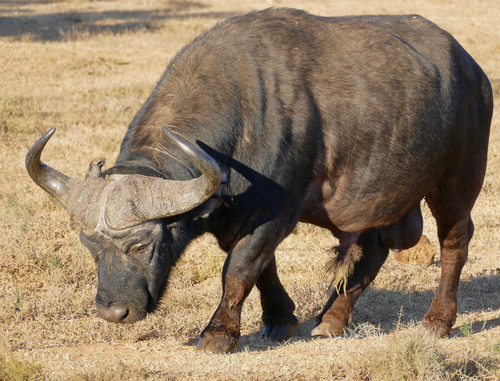
African Buffalo
Syncerus caffer
The African Buffalo is a powerful, unpredictable icon of the savanna, famous for its massive bone shield and unwavering herd loyalty. Discover how to track this 'Big Five' legend with AI-powered trail cameras.
Quick Identification
Size
Length: 1.7–3.4 m (5.6–11.2 ft); Shoulder height: 1.0–1.7 m (3.3–5.6 ft); Weight: 500–1,000 kg (1,100–2,200 lb)
Colors
Adults are typically dark grey or charcoal black; juveniles and the forest subspecies are often reddish-brown.
Key Features
- Fused horn bases forming a solid bone 'boss'
- Massive, barrel-shaped body
- Large, fringed ears set below the horns
- Sparse, coarse dark hair
When You’ll See Them
Sightings on EverydayEarth
Jul 30, 2026
A massive herd of African buffalo has gathered at a watering hole under the bright midday sun. Many individuals are standing deep in the water to cool off, while a long line of others drinks from the muddy bank. Small oxpeckers are busy flitting between the buffalo, perched on their backs and heads to glean parasites. The scene is one of calm social activity as the herd utilizes this vital water source.
Jul 24, 2026
A small herd of African Buffalo is gathered at a waterhole during the day. Three individuals stand at the water's edge drinking, while a fourth stands slightly further back near the brush before moving toward the water. Their reflections are clearly visible in the calm surface of the pond.
Jul 23, 2026
Two African Buffalo are present at the waterhole during the night. One individual stands at the edge drinking while its reflection is visible in the still water. A second buffalo walks steadily across the background from right to left.
Jul 22, 2026
A group of African Buffalo is cooling off and drinking in the center of the waterhole. On the right bank, several Common Wildebeest are active, with some individuals walking toward the water while others stand nearby. The scene is bustling with activity as these large herbivores share the water source.
Jul 21, 2026
A small herd of African Savanna Elephants is gathered at the waterhole, with several individuals drinking and others standing along the muddy bank. On the far left, a lone African Buffalo is also seen drinking at the water's edge. The scene is set against a backdrop of arid hills under a clear blue sky.
Jul 18, 2026
A group of African Savanna Elephants is gathered at the waterhole, with several individuals actively drinking and others standing nearby. In the background, two African Buffalo enter the frame from the right side, walking across the dry ground toward the water.
Geographic range
Where Does the African Buffalo Live?
The African Buffalo is a cornerstone of the Sub-Saharan wilderness, with a range that stretches from the southern edge of the Sahara down to the tip of South Africa. While their distribution is now fragmented due to human settlement, they remain abundant in protected regions of East and Southern Africa, particularly in the Serengeti and Kruger ecosystems. These resilient bovines inhabit everything from lowland rainforests in Central Africa to high-altitude moorlands, provided there is enough grass and water to sustain their massive bulk.
Basemap © OpenStreetMap contributors
Behavior
African Buffaloes are intensely social animals that live in massive herds, sometimes numbering in the thousands on the open savannas. Within these groups, they exhibit a fascinating 'democratic' behavior; when it is time to move, individuals will stand and face the direction they wish to go, and the herd eventually moves in the direction favored by the majority. They are famous for their collective defense, often rushing to protect a herd member—even a calf—from predators like lions.
Known as one of the 'Big Five' and sometimes nicknamed the 'Black Death,' they have a reputation for being unpredictable and dangerous, especially when solitary or wounded. Unlike their Asian relatives, they have never been domesticated due to this volatile temperament. They spend much of their day alternating between grazing in the open and ruminating in the shade to avoid the midday heat.
EverydayEarth exclusive
Camera Tips
To capture the majesty of the African Buffalo, focus your camera placement on permanent water holes or well-used wallows. Buffaloes are water-dependent and will visit these spots daily, especially during the dry season. Mount your camera at a height of approximately 4 to 5 feet (about 1.2 to 1.5 meters) to capture a clear view of their impressive horn boss and facial features. Because they are large and powerful, ensure your camera is secured with a heavy-duty security box and a python cable to a very sturdy tree—smaller trees may be used as rubbing posts, which could destroy your equipment.
Given that buffalo often travel in large, fast-moving herds that kick up significant amounts of dust, use a camera with a high-speed trigger (0.3 seconds or less) and a fast recovery time. Set the camera to 'Burst Mode' to take 3 to 5 photos per trigger event. This increases your chances of getting a clear shot of individual animals amidst the moving herd and helps document social interactions like nursing or sparring.
Lighting can be a challenge because of the buffalo's dark, non-reflective coat. If your camera has adjustable flash settings, use a 'High' or 'Extended Range' IR flash to ensure the buffalo doesn't appear as a featureless black silhouette at night. During the day, look for trails that lead from open grazing areas into thick brush; these 'tunnels' provide excellent framing and more consistent lighting for your shots than the harsh, direct sun of the open savanna.
Similar Species
Species that look similar or are commonly confused with African Buffalo.
Frequently Asked Questions
Record African Buffalo at your habitat
Connect a camera to start building your own species record — AI identifies every visitor automatically.