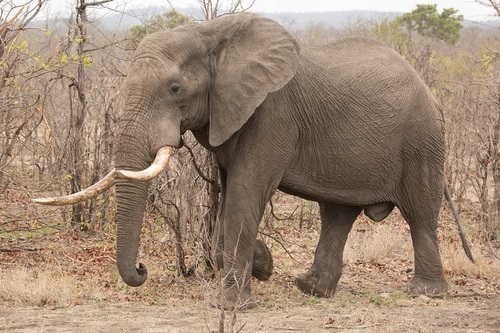
African Savanna Elephant
Loxodonta africana
The largest land animal on Earth, the African Savanna Elephant is a marvel of intelligence, social complexity, and raw power. From their ground-shaking rumbles to their delicate trunk movements, these 'ecosystem engineers' define the spirit of the wild African landscape.
Quick Identification
Size
Shoulder height of 3.0–4.0 meters (10–13 ft); weighs 5,000–10,400 kg (11,000–23,000 lbs)
Colors
Uniformly grey skin, though often appears reddish or brown from mud bathing; ivory-white tusks
Key Features
- Massive fan-shaped ears used for cooling
- Long prehensile trunk with two finger-like tips
- Large ivory tusks present in both males and females
- Distinctly concave (saddle-shaped) back
When You’ll See Them
Sightings on EverydayEarth
Apr 30, 2026
An African Elephant is resting on its side in tall, green grass. It appears to be sleeping or relaxing, with its body partially covered in reddish-brown mud. Another dark-colored animal is partially visible standing nearby in the background.
Aug 2, 2026
An African elephant stands at the edge of a waterhole in the woodland savanna. The elephant is seen in profile, calmly using its trunk to drink from the pool of water.
Aug 2, 2026
An African elephant is observed at a woodland waterhole during the morning hours. It stands at the water's edge, using its trunk to draw water and splash near the bank, a typical hydration and cooling behavior in the South African bushveld.
Aug 2, 2026
A lone African Elephant is seen standing at the edge of a waterhole in the bright morning light. The elephant has its trunk lowered toward the water, likely drinking or bathing itself while its reflection is visible on the still surface of the pond.
Aug 2, 2026
An African elephant stands at the edge of a tranquil watering hole, using its trunk to drink. The sun is high in a clear sky, casting a sharp shadow of the massive animal onto the dry earth as it quietly interacts with the water.
Aug 2, 2026
A family group of African Savanna Elephants, including adults and smaller calves, slowly walks away from the waterhole across the dry ground. In the foreground, a Nile Crocodile remains perfectly still on the bank near the edge of the water.
Geographic range
Where Does the African Savanna Elephant Live?
The African Savanna Elephant is native to the vast landscapes of sub-Saharan Africa, with its presence spanning across 37 different countries. These giants are most heavily concentrated in the protected parks and communal lands of Southern and East Africa, particularly within the 'KAZA' transfrontier conservation area that links Botswana, Namibia, Zimbabwe, and Zambia. While their range has contracted significantly due to human expansion, they remain the undisputed kings of the African plains, from the arid Kunene region to the lush savannas of the Serengeti.
Basemap © OpenStreetMap contributors
Recorded on EverydayEarth
Behavior
African Savanna Elephants are deeply social and intelligent creatures, living in complex matriarchal societies led by the oldest and wisest female. These herds consist of related females and their offspring, while adult bulls typically live solitary lives or form loose 'bachelor' groups. They communicate through a sophisticated range of vocalizations, including low-frequency infrasound that can travel several kilometers through the ground, allowing herds to stay in touch even when miles apart.
Known as 'ecosystem engineers,' their behavior significantly reshapes the landscape. They knock over trees to create grasslands and dig water holes that benefit other wildlife. In areas where they coexist with humans, they can be quite bold, sometimes raiding crops or wandering near settlements, which requires careful management to ensure the safety of both the giants and the local communities. They are highly emotional animals, known to show grief for deceased family members and maintain long-term bonds.
EverydayEarth exclusive
Camera Tips
Capturing an African Savanna Elephant on camera requires thinking big—literally. Because of their immense size and strength, standard camera mounts are rarely enough. If you are setting up a camera in an area they frequent, use a heavy-duty steel security housing (bear box) and lag-bolt it into a very thick, sturdy tree or a reinforced concrete post. Elephants are notoriously curious and will often use cameras as scratching posts or simply pull them down to investigate with their trunks.
For the best framing, place your camera higher than usual—about 6 to 8 feet up—and angle it slightly downward. This prevents the camera from just capturing 'belly shots' of a passing giant and protects it from being bumped. If you want dramatic, intimate footage, place a camera near a known water hole or a well-worn 'elephant highway' (game trail). Use a wide-angle lens setting if your camera allows it, as a standard field of view often cuts off the elephant's head or feet when they are close.
Avoid using any scented lures; the elephant’s sense of smell is legendary, and they may be attracted to the scent of your hands or the plastic, leading to gear damage. Use a high-speed SD card and set your camera to take short video clips (15-30 seconds) rather than just stills. Seeing the fluid movement of the trunk and the social interaction between herd members provides far more insight than a single photo. Ensure your trigger speed is fast—while they look slow, their stride covers ground surprisingly quickly.
Similar Species
Species that look similar or are commonly confused with African Savanna Elephant.
Frequently Asked Questions
Record African Savanna Elephant at your habitat
Connect a camera to start building your own species record — AI identifies every visitor automatically.