African Wild Dog
Lycaon pictus
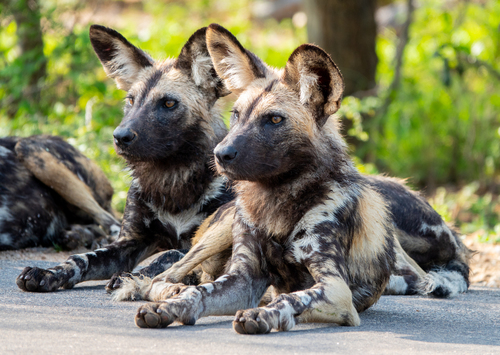
Known as the 'Painted Wolf,' the African Wild Dog is one of the world's most successful and social predators, instantly recognizable by its striking patchwork coat and large, rounded ears.
Quick Identification
Size
Head and body length of 75–110 cm (30–43 in) with a weight range of 18–36 kg (40–79 lb)
Colors
Patchwork 'painted' coat of yellow, black, and white; black muzzle; large dark ears; and a white-tipped tail
Key Features
- Large, rounded 'Mickey Mouse' ears for cooling and sound
- Unique patchwork coat patterns specific to every individual
- Lack of dewclaws on the front paws, leaving only four toes
- Bushy tail with a prominent white tip used as a visual signal
When You’ll See Them
Sightings on EverydayEarth
Jun 16, 2026
Two African Wild Dogs are resting on the ground during the night. One individual is curled up in the center of the frame, occasionally shifting its head and ears, while another is partially visible beside it. Their unique mottled patterns are evident against the dark substrate.
Jul 17, 2026
A group of White Rhinoceros are gathered together resting under the cover of trees. In the foreground, an African Wild Dog is lying down, occasionally moving its head and ears as it rests near the larger mammals.
Jul 2, 2026
A large pack of African Wild Dogs has gathered at the edge of a waterhole. Several individuals are actively drinking from the water, while others mill about on the muddy bank, interacting with one another in a social manner.
Jun 22, 2026
Two African Wild Dogs are resting on the open ground in the center of the scene. One dog shifts its head to look around while the other remains still. On the far right edge of the frame, a White Rhinoceros is partially visible, standing quietly in the darkness.
Jun 19, 2026
Under the glow of infrared light, a large White Rhinoceros rests quietly on the right. In the center of the scene, two African Wild Dogs are present; one is curled up asleep on the ground while the other sits upright, alertly scanning the surroundings and turning its head.
Jun 18, 2026
Under the cover of night, a group of African Wild Dogs is seen resting in a clearing. One dog is curled up tightly while another lies nearby, occasionally shifting its position. On the right side of the frame, a large White Rhinoceros is also resting on the ground, with its head and distinctive large ears visible near the camera.
Geographic range
Where Does the African Wild Dog Live?
Native to the vast landscapes of sub-Saharan Africa, the African Wild Dog thrives primarily in the savannas and arid shrublands of the continent's eastern and southern reaches. While their historical range once spanned nearly all of Africa, they are now most commonly found in strongholds such as Botswana's Okavango Delta, Tanzania's Selous Game Reserve, and Kruger National Park in South Africa. They are extremely rare in West and North Africa, where populations have faced significant fragmentation due to human encroachment.
Basemap © OpenStreetMap contributors
Behavior
African Wild Dogs are renowned for being the most social of all canids. They live in tightly integrated packs that revolve around a dominant breeding pair, yet they lack the strict linear hierarchy seen in wolves. Pack members are incredibly altruistic, caring for sick or injured members and prioritizing the feeding of pups before the adults. Their social bond is reinforced through elaborate greeting rituals involving high-pitched vocalizations and muzzle-licking.
As cooperative hunters, they possess a success rate that dwarfs that of lions or leopards, often exceeding 60%. They are persistence hunters, chasing prey across the savanna until the target collapses from exhaustion. While they are apex predators, they are often outcompeted by larger carnivores like lions and hyenas, which frequently steal their kills. Consequently, wild dogs are highly mobile and rarely stay in one location for long, except during the denning season.
EverydayEarth exclusive
Camera Tips
Capturing the African Wild Dog on a trail camera requires a strategy built around movement corridors. Because these dogs are nomadic and can cover up to 50 kilometers in a single day, placing your camera on established game trails leading to permanent water sources is your best chance for success. Mount your camera at a medium height—roughly 60 to 70 centimeters off the ground—to capture their full profile and distinctive coat patterns, which are essential for identifying specific individuals or packs.
Since they are crepuscular, meaning they are most active during the low-light hours of dawn and dusk, a camera with a high-quality infrared flash and a fast trigger speed (0.3 seconds or less) is mandatory. They move with incredible speed and agility; a slow camera will often yield nothing but a blurry tail or a 'ghost' image. Use a multi-shot or 'burst' mode to ensure you catch the entire pack as they trot past in a line, as the lead dog often triggers the sensor while subsequent dogs provide the best clear shots.
In terms of settings, high-definition video is often more rewarding than stills for this species, as it captures their unique 'chirping' vocalizations and fascinating social interactions. If you are operating in a private conservancy or a large farm where they are known to transit, placing cameras near intersections of fence lines or large clearings can be productive. Avoid using meat-based baits, as this can attract lions or hyenas which may damage your equipment or displace the wild dogs you are trying to document.
Similar Species
Species that look similar or are commonly confused with African Wild Dog.
Frequently Asked Questions
Record African Wild Dog at your habitat
Connect a camera to start building your own species record — AI identifies every visitor automatically.