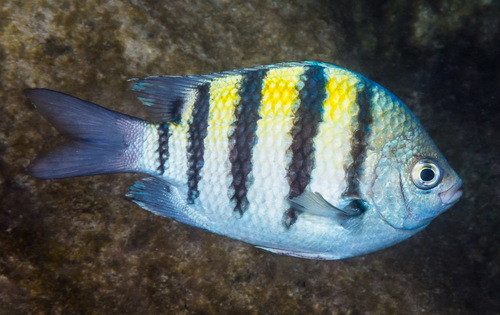
Atlantic Sergeant Major
Abudefduf saxatilis
The Atlantic Sergeant Major is the bold, striped sentinel of the sea. Famous for their military-like precision and fearless attitude, these vibrant fish are the true stars of shallow-water reefs and coastal docks.
Quick Identification
Size
Up to 22.9 cm (9 inches) in length; typically averages 15 cm (6 inches)
Colors
Silvery-white to gray body with five prominent vertical black bars; upper body often displays a bright yellow wash. Males turn dark blue or purple during spawning.
Key Features
- Five distinct vertical black bars along the sides
- Bright yellow coloration on the dorsal surface
- Deeply forked tail fin
- Small mouth with a single row of teeth
When You’ll See Them
Sightings on EverydayEarth
Jul 26, 2026
A vibrant underwater scene showing a variety of reef fish active around a dense coral structure. Schools of bright blue fish hover in the open water while striped fish navigate between the swaying sea fans and coral heads.
Jul 26, 2026
On a vibrant coral reef, several small fish dart among swaying sea fans and sea whips. A Bicolor Damselfish is prominently visible in the mid-ground, hovering near the coral structures, while small Blue Chromis and an Atlantic Sergeant Major swim in the clear blue water above the reef wall. The scene is illuminated by sunlight filtering through the ocean surface.
Jul 26, 2026
A vibrant reef scene is filled with activity. A Schoolmaster snapper swims slowly near the bottom among sea fans and coral. In the water column above, schools of Blue Chromis and yellow Bluehead Wrasse dart around. A Bicolor Damselfish is visible near the reef structure in the lower left, while a Sergeant Major passes through the upper right of the frame.
Jul 21, 2026
A very busy coral reef scene features high biodiversity. Numerous small, bright blue fish swim in the upper water column while several striped fish and yellow wrasses forage near the swaying sea fans. A larger, silvery fish with a dark line along its back swims across the frame, passing by brain corals and complex reef structures. The entire scene is in constant motion from the surge and active fish behavior.
Jul 20, 2026
The reef is bustling with activity as several species of tropical fish navigate the coral structures. Bicolor Damselfish are active near the substrate, while a terminal phase Bluehead Wrasse and a Blue Tang swim through the open water. In the background, a school of Sergeant Majors drifts above the reef wall.
Jul 19, 2026
A vibrant and busy reef scene shows high biodiversity. Dozens of Caribbean Bluehead Wrasse dart between the coral heads, while a Western Atlantic Trumpetfish glides slowly across the top of the frame. An Atlantic Sergeant Major is visible near a large sea fan, and a school of French Grunts occupies the lower reef. In the background, Blue Chromis swim in the open water while a large Stoplight Parrotfish passes through.
Geographic range
Where Does the Atlantic Sergeant Major Live?
The Atlantic Sergeant Major is native to the warm tropical and subtropical waters of the Atlantic Ocean, ranging as far north as Rhode Island and down to Uruguay in the west. In the eastern Atlantic, they are commonly found from Morocco down to Angola, including the Cape Verde islands. They are most densely populated throughout the Caribbean Sea, the Gulf of Mexico, and the coast of Florida, where they are a signature species of the shallow reef environment.
Basemap © OpenStreetMap contributors
Recorded on EverydayEarth
Behavior
Atlantic Sergeant Majors are highly social and energetic fish, frequently seen in large, bustling schools while foraging for food in the water column. They are incredibly bold and curious by nature, often approaching snorkelers and divers without hesitation. Their name reflects their 'military' appearance and their disciplined, aggressive defense of their territory, especially during the nesting season.
During breeding, the species undergoes a fascinating behavioral shift. Males take on the role of egg guardians, turning a deep, dusky blue to signal their status. They meticulously clean a patch of rock or pier piling where the female deposits her eggs, and then they spend days fiercely defending that patch from any intruders, regardless of size. Outside of breeding, they are peaceful opportunists that play a vital role in keeping reef and dock ecosystems clean by grazing on algae and small invertebrates.
EverydayEarth exclusive
Camera Tips
To capture the best footage of the Atlantic Sergeant Major, your camera should be positioned near vertical structures like dock pilings or rocky reef edges. These fish are naturally attracted to these surfaces for protection and feeding. If you are using an underwater camera setup, a wide-angle lens is essential to capture the movement of the entire school, as they often move in large, synchronized groups that can fill the frame quickly.
Lighting is the biggest challenge for underwater photography. For the most vibrant results, aim to record between 10 AM and 2 PM when the sun is directly overhead. This provides the best penetration through the water column, highlighting the bright yellow on their backs and the deep black of their stripes. If your camera is in a fixed position, ensure it is facing away from the direct sun to avoid glare and 'wash-out' from the surface reflection.
You can encourage activity in front of your lens by choosing a site with active algae growth or near 'cleaning stations' on a reef. While they are naturally curious and will often investigate a camera lens on their own, a small amount of fish-safe food placed in a mesh bag near the camera can create a spectacular feeding frenzy. However, even without bait, they are incredibly active; simply mounting a camera to a pier in a high-traffic coastal area is usually enough to guarantee multiple sightings within an hour.
During the summer months, keep a lookout for males that have turned a dark, smoky blue. If you find one, it is likely guarding a nest of purple or red eggs. This is the perfect opportunity for a time-lapse or long-duration recording. The male will stay within a very small area, providing a consistent subject as he meticulously cleans the eggs and fends off other fish, offering a rare glimpse into their complex social and reproductive lives.
Similar Species
Species that look similar or are commonly confused with Atlantic Sergeant Major.
Night Sergeant
Larger and browner than the Atlantic Sergeant Major, it lacks the bright yellow coloring and prefers more turbulent, surf-pounded rocky areas.
Panamic Sergeant Major
Visually nearly identical but found in the Pacific Ocean; they are geographically separated by the Isthmus of Panama.
Sheepshead
Much larger with more bars (usually 5-6), a blunt snout, and a lack of any yellow pigmentation on the back.
Frequently Asked Questions
Record Atlantic Sergeant Major at your habitat
Connect a camera to start building your own species record — AI identifies every visitor automatically.