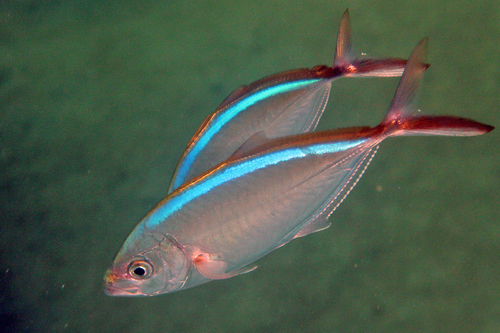
Bar Jack
Caranx ruber
A sleek and fast-moving predator of the Atlantic, the Bar Jack is easily recognized by its signature dark racing stripe and electric blue accents. Whether patrolling solo or in massive, shimmering schools, these energetic fish are a hallmark of healthy coral reef ecosystems.
Quick Identification
Size
Typically 25–40 cm (10–16 in) in length, with a maximum recorded length of 65 cm (26 in) and a weight of 6.8 kg (15 lb).
Colors
Silvery-grey to white belly with a distinct dark horizontal bar along the back and lower tail; a bright electric blue stripe often highlights the dark bar.
Key Features
- Dark horizontal bar running along the back and through the lower caudal fin lobe
- Electric blue stripe immediately below the dark bar
- Deeply forked tail fin
- Streamlined, compressed silvery body
When You’ll See Them
Sightings on EverydayEarth
Aug 1, 2026
In a sunny, shallow reef area with a sandy floor, a Spotted Trunkfish swims slowly across the frame, showcasing its black-spotted pattern. The footage then transitions to a deeper, blue-water environment along a steep reef wall, where a school of Bar Jacks and a bright Atlantic Blue Tang swim past coral formations.
Jul 21, 2026
A very busy coral reef scene features high biodiversity. Numerous small, bright blue fish swim in the upper water column while several striped fish and yellow wrasses forage near the swaying sea fans. A larger, silvery fish with a dark line along its back swims across the frame, passing by brain corals and complex reef structures. The entire scene is in constant motion from the surge and active fish behavior.
Jul 3, 2026
A Bar Jack swims steadily through the upper water column above a healthy reef. In the background, the coral and sea fans sway gently with the surge, and several smaller fish are visible darting among the crevices of the reef structure.
Jul 3, 2026
An active underwater scene on a Caribbean reef. A Bar Jack swims steadily across the upper part of the frame, while smaller Blue Chromis dart through the water column above the coral. The reef is populated with sea fans and gorgonians that sway rhythmically with the underwater surge under bright, filtered sunlight.
Jun 16, 2026
A pair of Spotted Eagle Rays glides gracefully through the open water, showcasing their striking white-spotted patterns. The camera then captures a busier scene along the reef where a group of Nurse Sharks is seen swimming together. They are surrounded by active schools of fish, including Yellowtail Snappers and Bar Jacks, moving among the colorful coral and sea fans.
Jun 9, 2026
Multiple Bar Jacks are seen swimming across the reef, characterized by their bright yellow tails. Simultaneously, a large school of tiny, slender fish drifts and darts through the upper water column over the rocky coral seabed.
Geographic range
Where Does the Bar Jack Live?
The Bar Jack is native to the warm tropical and subtropical waters of the western Atlantic Ocean. Its range extends from the coast of New Jersey and Bermuda southward through the Gulf of Mexico and the Caribbean Sea, reaching as far as Venezuela and Brazil. They are most densely populated in the West Indies, where they thrive in the high-visibility waters of the coral reef systems.
Basemap © OpenStreetMap contributors
Recorded on EverydayEarth
Behavior
While they are usually active during the day, their hunting patterns are highly opportunistic. In reef environments, they act as mid-water hunters, often darting into schools of smaller baitfish with impressive speed and precision. They are naturally curious and often approach snorkelers or stationary objects, making them a frequent subject for underwater photography.
EverydayEarth exclusive
Camera Tips
Because Bar Jacks are attracted to movement and 'commensal' hunting opportunities, setting your camera near a stingray’s favorite digging spot can yield excellent results. They are naturally curious, so even a stationary camera housing may pique their interest, leading to dramatic, high-definition close-up shots. Avoid using heavy flash in clear water to prevent 'backscatter' (lighting up floating particles), and instead rely on natural light during the peak midday hours when their iridescent markings are most vivid.
Timing is crucial for capturing action shots; Bar Jacks are most active during the rising tide when nutrient-rich water flows over the reef, bringing in the baitfish they crave. If you are using a triggered system, use a fast shutter speed to freeze their lightning-fast strikes. During the summer months, keep an eye out for larger aggregations, as this is when they congregate for spawning, providing a spectacular display of social behavior that is a highlight for any marine backyard observer.
Similar Species
Species that look similar or are commonly confused with Bar Jack.
Frequently Asked Questions
Record Bar Jack at your habitat
Connect a camera to start building your own species record — AI identifies every visitor automatically.