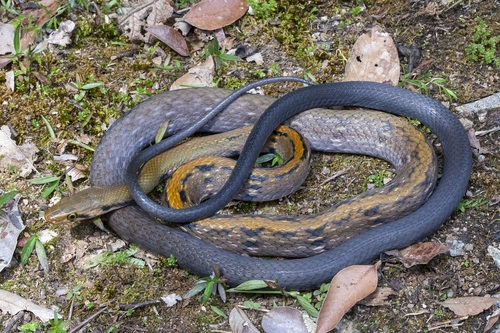
Black Copper Rat Snake
Coelognathus flavolineatus
A striking and beneficial garden visitor, the Black Copper Rat Snake is Southeast Asia's master of rodent control, easily recognized by its copper-toned head and brilliant yellow tail stripe.
Quick Identification
Size
120-180 cm (4-6 feet), occasionally reaching up to 200 cm (6.5 feet)
Colors
Copper or tan forebody with black spots; rear body is black or dark grey with a prominent yellow stripe down the spine
Key Features
- Distinct yellow stripe on the rear half of the body
- Dark stripe extending behind the eye
- Front body tan/copper with dark 'saddle' markings
- S-shaped defensive posture when threatened
When You’ll See Them
Geographic range
Where Does the Black Copper Rat Snake Live?
The Black Copper Rat Snake is a quintessential Southeast Asian species, thriving in the warm, humid environments of the Indo-Malayan region. Its native range stretches from southern Thailand and Myanmar through Peninsular Malaysia and Singapore, extending deep into the Indonesian archipelago including Sumatra, Java, and Borneo. It is a highly adaptable snake, frequently found in human-modified landscapes such as rubber plantations and rural villages throughout Vietnam and Brunei.
Basemap © OpenStreetMap contributors
Behavior
The Black Copper Rat Snake is a fast-moving, terrestrial hunter that is highly active during daylight hours. While it primarily stays on the ground searching through leaf litter and rodent burrows, it is an agile climber capable of scaling low trees and garden walls. It is a non-venomous constrictor, meaning it overpowers its prey by wrapping its muscular body around it rather than using venom.
This species is well-known for its dramatic defensive display. When it feels cornered, it will inflate its neck vertically to appear larger and coil the front of its body into a tight 'S' shape, occasionally lunging with an open mouth. Despite this 'fierce' appearance, they are generally shy snakes that prefer to flee into thick vegetation or down a hole if they sense a human approaching.
EverydayEarth exclusive
Camera Tips
To capture a Black Copper Rat Snake on camera, focus your efforts on 'edge' habitats in your garden or backyard. These snakes love to travel along the base of walls, fences, or dense hedges where they feel protected while searching for prey. Position your camera just 15-20 cm (6-8 inches) off the ground, angled slightly downward to catch the distinctive yellow stripe on their back, which is their most identifying feature from a top-down view.
Since these snakes are diurnal, you don't need to worry about infrared flash as much as trigger speed. They can move quite quickly when transiting between cover, so a camera with a trigger speed under 0.5 seconds is ideal. Set your device to 'Video' or 'Burst Mode' to ensure you get more than just a blurry tail. A 10-second video clip is often the best way to observe their fluid movement and the beautiful transition from copper-tan to deep black along their body.
Natural lures are more effective than artificial bait for this species. If you have a garden pond or a consistent water source, place your camera there; these snakes often visit water to drink or hunt for frogs during the hottest part of the day. Additionally, if you have a woodpile or compost heap that attracts mice, that is a prime location for a trail camera. The best time for activity is typically mid-morning when the sun has warmed the ground but before the peak heat of midday.
Frequently Asked Questions
Record Black Copper Rat Snake at your habitat
Connect a camera to start building your own species record — AI identifies every visitor automatically.