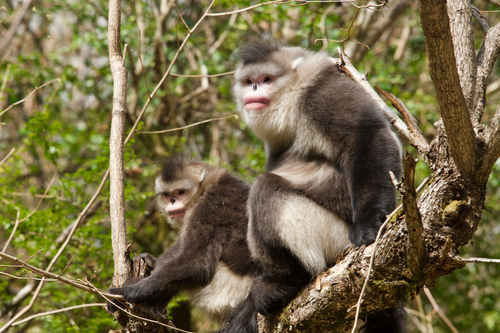
Black Snub-nosed Monkey
Rhinopithecus bieti
The Black Snub-nosed Monkey is a true survivor, thriving in the frost-covered Himalayan forests at altitudes where few other primates could breathe. Known for its striking black-and-white coat and unique upturned nose, it is one of the world's most elusive and endangered mountain dwellers.
Quick Identification
Size
Body length 51-83 cm (20-33 in); Weight 9-15 kg (20-33 lbs)
Colors
Contrast of black and white; black on limbs, back, and crown; white on belly, rump, and inner limbs; pink fleshy lips
Key Features
- Upturned snub nose with forward-facing nostrils
- Long, thick black and white fur adapted for cold
- Fleshy pink lips on a pale white face
- Large, bushy tail often longer than the body
When You’ll See Them
Geographic range
Where Does the Black Snub-nosed Monkey Live?
Native to the eastern edge of the Himalayan massif in Southwest China, the Black Snub-nosed Monkey is found exclusively in the Yunling Mountains. Its core range is restricted to a narrow corridor between the Lancang (Mekong) and Jinsha (Yangtze) rivers within the Yunnan and southeastern Tibet provinces. These monkeys inhabit some of the most isolated and rugged terrain in the region, with no known populations introduced outside of their native Chinese range.
Basemap © OpenStreetMap contributors
Behavior
The Black Snub-nosed Monkey is a highly social primate that lives in a multi-level society. Their basic social unit is a 'one-male unit' consisting of a single breeding male, several females, and their offspring. These units often congregate into much larger bands that can number over 400 individuals, particularly when moving between foraging grounds or resting. They spend a significant amount of time grooming one another, which helps maintain social bonds and keeps their thick fur clean of debris.
These monkeys are remarkably resilient, living at higher altitudes than almost any other non-human primate. They are adapted to sub-freezing temperatures and thin air, moving with agility through both the canopy of coniferous forests and across rugged, rocky terrain. While they are primarily arboreal, they will descend to the ground to travel between forest patches or to forage for fallen lichens and ground-dwelling herbs.
EverydayEarth exclusive
Camera Tips
To capture the Black Snub-nosed Monkey on a trail camera, focus your efforts on high-altitude movement corridors. Because these primates often travel in large bands, they create recognizable 'monkey trails' through the underbrush or across rocky ridges. Position your camera at a height of 5 to 7 feet, angled slightly downward to capture the activity on the forest floor, as they frequently descend from the canopy to cross gaps in the trees or drink from mountain streams.
Baiting is generally not recommended or effective for this species due to their specialized diet; however, placing cameras near trees heavily draped in pale green filamentous lichens (Usnea) is a winning strategy. These lichens are their primary food source, and monkeys will often linger in these 'hanging gardens' to feed for extended periods. Ensure your camera is set to a high-speed burst mode (3-5 photos per trigger), as the lead male is often followed by dozens of others, and a single shot will likely miss the bulk of the troop.
Environmental factors are a major challenge when filming this species. Because they live in sub-freezing conditions, standard alkaline batteries will fail quickly. Always use high-quality lithium batteries and ensure your camera housing is rated for extreme cold and high humidity. In the thin mountain air, the morning sun can be incredibly bright, so aim your lens away from the direct east-west path to prevent washed-out images during their peak morning activity hours.
Similar Species
Species that look similar or are commonly confused with Black Snub-nosed Monkey.
Frequently Asked Questions
Record Black Snub-nosed Monkey at your habitat
Connect a camera to start building your own species record — AI identifies every visitor automatically.