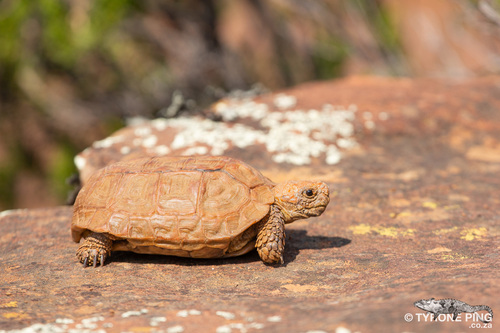
Boulenger's Cape tortoise
Chersobius boulengeri
A pint-sized survivor of the South African desert, the Karoo padloper is a master of hiding in plain sight among the rocks.
Quick Identification
Size
Shell length 8-11 cm (3-4.5 inches); Weight 100-250g (3.5-8.8 oz)
Colors
Uniform reddish-brown to olive-brown carapace; yellowish-brown limbs and head; lacks bold patterns found in other padlopers
Key Features
- Extremely flattened (depressed) shell profile
- Large overlapping scales on forelimbs
- Hooked upper jaw (beak)
- Five claws on the front feet
When You’ll See Them
Geographic range
Where Does the Boulenger's Cape tortoise Live?
Boulenger's Cape tortoise is native to the African continent and is found exclusively within the borders of South Africa. Its core range is restricted to the arid Nama Karoo region, specifically spanning parts of the Northern Cape, Western Cape, and Eastern Cape provinces. This species is a true local specialist, found nowhere else on Earth outside this rugged, semi-desert landscape.
Basemap © OpenStreetMap contributors
Behavior
Boulenger's Cape tortoise, often called the Karoo padloper, is a master of concealment. Unlike many other tortoises that rely solely on their hard shells for protection, this species has evolved a flattened body shape that allows it to wedge itself deep into narrow rock crevices. This behavior, known as being 'rupicolous' or rock-dwelling, protects them from both predators and the extreme temperature fluctuations of the South African desert.
These tortoises are generally solitary and can be quite shy. They are most active during the cooler hours of the morning and late afternoon, spending the heat of the midday tucked away in the shade of rocks or shrubs. During the harsh, dry winters or prolonged droughts common in the Karoo, they may enter a state of dormancy, emerging only when the arrival of rains triggers a flush of new plant growth.
EverydayEarth exclusive
Camera Tips
Capturing Boulenger's Cape tortoise on camera requires a strategic 'ground-up' approach. Because these tortoises are exceptionally small and stay low to the earth, your camera should be mounted no more than 10-15 centimeters (4-6 inches) off the ground. If you are using a standard trail camera, tilt it slightly downward to ensure the sensor triggers on a creature that is only a few inches tall. A wide-angle lens is preferable to capture the surrounding rocky terrain where they spend most of their time.
Focus your efforts on 'high-traffic' areas such as the base of shale ridges or near clusters of succulent plants. These tortoises often use the same rock crevices for years, so if you find a narrow horizontal crack with signs of use (like small droppings or cleared dust), that is a prime spot for a camera setup. Positioning a camera near a natural depression in the rock that collects rainwater can also be highly effective, as the tortoises will travel to these 'mini-oases' to drink after a storm.
Timing is everything with this species. They are most likely to emerge and move about immediately following rain showers, which stimulate their appetite for fresh succulents. Set your camera to 'Burst Mode' or high-frequency photo capture. Because they move slowly, a video setting can be wonderful for observing foraging behavior, but ensure the PIR (passive infrared) sensitivity is set to 'High' to detect the small heat signature of a cold-blooded reptile against the warm Karoo soil.
Frequently Asked Questions
Record Boulenger's Cape tortoise at your habitat
Connect a camera to start building your own species record — AI identifies every visitor automatically.