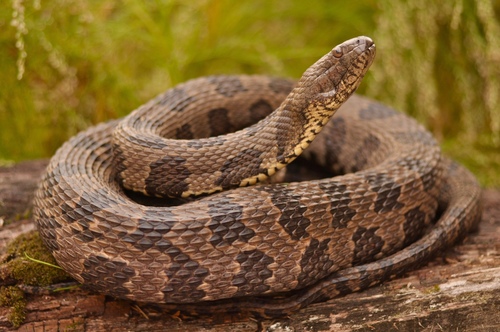
Brown Watersnake
Nerodia taxispilota
A heavy-bodied master of the southern waterways, the Brown Watersnake is most at home sunning on a cypress knee or patrolling the riverbank for fish. Though often misunderstood, this impressive reptile is an essential indicator of a healthy aquatic ecosystem.
Quick Identification
Size
30-60 inches (76-152 cm) in length; large females can occasionally exceed 5 feet (152 cm)
Colors
Light brown to tan ground color with large, dark brown, square-shaped blotches arranged in a checkerboard pattern along the back and sides.
Key Features
- Large square-shaped dark blotches that do not meet the belly scales
- Bulging eyes located near the top of the head
- Heavy, thick-set body with keeled (ridged) scales
- Dark vertical bars on the labial scales (lip scales)
When You’ll See Them
Geographic range
Where Does the Brown Watersnake Live?
Native to the North American continent, the Brown Watersnake is a signature species of the southeastern United States. Its core range spans the coastal plain and piedmont regions from southeastern Virginia down through the Carolinas and Georgia, covering the entire Florida peninsula and extending west into eastern Alabama. These snakes are intrinsically tied to freshwater systems, meaning their distribution follows the corridors of major river basins and sprawling swamp networks throughout the humid subtropical South.
Basemap © OpenStreetMap contributors
Behavior
The Brown Watersnake is a highly aquatic and diurnal reptile, famously known for its habit of basking on tree limbs overhanging rivers and swamps. When startled by a passing boat or predator, these snakes will drop directly into the water to escape—occasionally landing in boats by accident, which has led to many a tall tale about "attacking" snakes. In reality, they are non-venomous and generally flee from human interaction whenever possible.
While they are quite docile if left alone, they can be very defensive if cornered or handled. Like many watersnakes, they will flatten their heads to appear larger and may strike or release a foul-smelling musk to deter threats. Despite their somewhat intimidating appearance and large size, they are harmless to humans and play a crucial role in maintaining healthy fish populations in southern waterways.
EverydayEarth exclusive
Camera Tips
To capture high-quality images of a Brown Watersnake, your best bet is to focus on 'basking architecture.' Look for fallen logs or low-hanging branches that extend over the water in sunny spots. These snakes are ectothermic and spend hours each morning thermoregulating. Mount your camera on a nearby tree or a specialized T-post near the bank, angling it toward the most prominent sun-exposed log.
Standard PIR (Passive Infrared) triggers often fail to detect snakes because their body temperature closely matches the environment. To overcome this, use your camera’s Time-Lapse mode during the day. Setting the camera to take a photo every 2 to 5 minutes between 9:00 AM and 3:00 PM will significantly increase your chances of 'catching' a snake as it moves onto its basking spot.
If you are using a camera with high sensitivity settings, place it low to the ground—about 12 to 18 inches high—along the shoreline or a 'haul-out' spot where the bank meets the water. These are the transit paths snakes use to move between hunting and resting areas. Ensure your camera is in a waterproof housing, as these areas are prone to sudden water level rises after heavy rain.
For night captures, use a camera with 'No-Glow' or 'Black Flash' infrared LEDs. Brown Watersnakes become active hunters after dark in the heat of summer. High-speed triggers are less important than a wide-angle lens, as the snakes move slowly while foraging along the water's edge. Avoid using white flash, which can startle the snake and cause it to dive, ending your photo session instantly.
Frequently Asked Questions
Record Brown Watersnake at your habitat
Connect a camera to start building your own species record — AI identifies every visitor automatically.