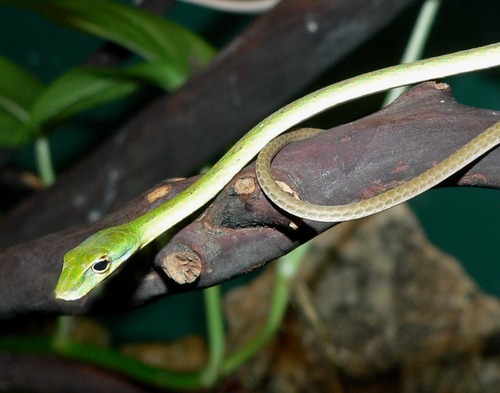
Burmese Vine Snake
Ahaetulla fronticincta
A master of camouflage and aquatic precision, the Burmese Vine Snake is a rare specialist that stalks fish from the treetops. Its striking emerald body and unique horizontal pupils make it a crown jewel of the Southeast Asian wetlands.
Quick Identification
Size
60-100 cm (24-39 inches) in length; exceptionally slender, whip-like body
Colors
Bright lime green or grass green dorsally; pale green or yellowish belly; occasionally shows black and white checkered patterns when defensive
Key Features
- Distinctive horizontal 'keyhole' pupils
- Elongated, pointed snout
- Extremely slender, vine-like body
- Specialized for fish-hunting from overhanging branches
When You’ll See Them
Geographic range
Where Does the Burmese Vine Snake Live?
Where Does the Burmese Vine Snake Live? This species is native to Southeast Asia, with its core population centered in Myanmar (Burma). It thrives along the coastal regions and major river systems of the Irrawaddy delta and is frequently found in mangrove ecosystems. While primarily associated with Myanmar, sightings have been recorded in neighboring regions of India and potentially Thailand, favoring humid, lowland environments where thick forest meets the water's edge.
Basemap © OpenStreetMap contributors
Behavior
The Burmese Vine Snake is a highly specialized arboreal hunter known for its remarkable patience and precision. Unlike many other vine snakes that hunt lizards, this species is a 'river specialist,' often found draped over branches that overhang slow-moving water or tidal mudflats. It uses its binocular vision—aided by unique horizontal pupils—to track movement below the surface before striking with lightning speed to snag small fish.
While they possess a mild venom used to subdue their prey, they are generally considered harmless to humans and are not aggressive. When threatened, they may inflate their necks to reveal dark skin between their scales, a defensive display designed to make them look larger. They are solitary creatures and spend most of their lives in the canopy or on low-hanging branches near water sources.
EverydayEarth exclusive
Camera Tips
To capture the Burmese Vine Snake on camera, focus your efforts on 'edge' habitats where dense vegetation meets a water source. These snakes are ambush predators that spend hours motionless on branches overhanging rivers, ponds, or tidal creeks. Position your camera about 3 to 6 feet above the water level, angled slightly downward toward horizontal branches that dip near the surface. Because they are extremely slender and match the foliage perfectly, use high-resolution settings to ensure their thin profiles are distinguishable from the leaves.
Because these snakes are diurnal, ensure your camera's PIR (Passive Infrared) sensor is optimized for daytime triggers. However, since snakes are ectothermic and may not always trigger traditional heat-based sensors, it is highly recommended to use 'Time Lapse' mode or a high-sensitivity motion detection setting. Aim for a fast shutter speed to capture their lightning-quick strikes if they dive for a fish, as the action happens in a fraction of a second.
Look for 'sun spots' where the canopy opens up over the water. Like all reptiles, the Burmese Vine Snake needs to thermoregulate, and they are often found basking in dappled sunlight during the mid-morning hours. If you are setting a camera in a backyard area near a pond, ensure there are native shrubs like hibiscus or mangroves nearby. Avoid using artificial lures; these visual hunters are attracted to the natural movement of small native fish and tadpoles.
Frequently Asked Questions
Record Burmese Vine Snake at your habitat
Connect a camera to start building your own species record — AI identifies every visitor automatically.