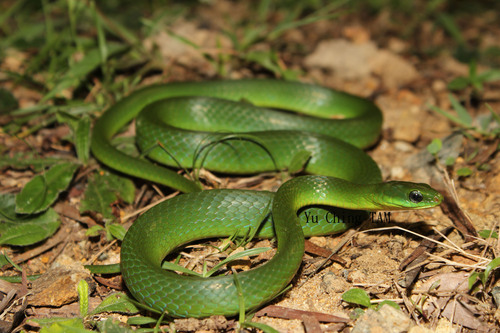
Chinese Green Snake
Ptyas major
Meet the vibrant, gentle emerald of the Asian garden. The Chinese Green Snake is a harmless, day-active beauty that spends its time hunting earthworms among the leaves.
Quick Identification
Size
Typically 75–120 cm (30–47 inches) in total length, with a very slender, whip-like body.
Colors
Brilliant uniform leaf-green on the back and sides; the belly is pale yellow to lime green. Males and females are visually identical.
Key Features
- Vibrant emerald-green dorsal scales
- Smooth, glossy scales with no keeling
- Relatively large eyes with round pupils
- Pale yellowish-white underside
When You’ll See Them
Geographic range
Where Does the Chinese Green Snake Live?
The Chinese Green Snake is native to the humid subtropical regions of East and Southeast Asia. Its core range spans Central and Southern China and Taiwan, extending southwards into Northern Vietnam and parts of Laos. This snake is a common sight in these regions, thriving in both pristine forests and human-altered landscapes like tea plantations and rural gardens where moisture is plentiful.
Basemap © OpenStreetMap contributors
Behavior
The Chinese Green Snake is a gentle, non-venomous reptile renowned for its exceptionally docile temperament. Unlike many other colubrids that may strike when cornered, this species rarely bites, making it a favorite among wildlife enthusiasts. It is strictly diurnal, meaning it is most active during the daylight hours when it can be seen gracefully navigating through low shrubs or foraging among leaf litter on the forest floor.
As a semi-arboreal species, it is highly agile both on the ground and in the canopy. It spends its nights coiled in the safety of dense foliage or tree hollows to avoid nocturnal predators. When threatened, its primary defense is its remarkable camouflage, which allows it to vanish into the green backdrop of its habitat. If further provoked, it may secrete a foul-smelling musk to deter attackers, but it almost always chooses flight over a fight.
EverydayEarth exclusive
Camera Tips
To capture the stunning Chinese Green Snake on camera, focus your efforts on damp, shaded areas of your backyard. Because they are specialist earthworm hunters, placing a camera near a well-maintained compost heap or a moisture-rich garden bed with plenty of leaf litter is your best bet. Look for 'corridors' where the lawn meets dense shrubbery, as they often utilize these edges for safe travel between hunting grounds while remaining hidden from hawks.
Set your camera at a very low angle, no more than 15 centimeters (6 inches) off the ground. A slight downward tilt helps capture the snake's entire length as it glides across the soil. If your AI-powered camera has a macro or close-focus feature, this is the time to use it, as these snakes are slender and can appear small on standard wide-angle trail cams. High-trigger speed is crucial; while they aren't the fastest snakes, their fluid movement can result in a blur if the camera is sluggish.
Since this species is strictly diurnal, you can optimize your camera's battery life by setting it to capture only during daylight hours. They are most active during the mid-morning and late afternoon when the sun is warm but not oppressive. During the hot summer months, they are frequently seen near garden ponds or birdbaths seeking hydration, so positioning a camera overlooking a low-profile water feature or a damp mossy rock is an excellent secondary strategy for getting a clear shot.
Frequently Asked Questions
Record Chinese Green Snake at your habitat
Connect a camera to start building your own species record — AI identifies every visitor automatically.