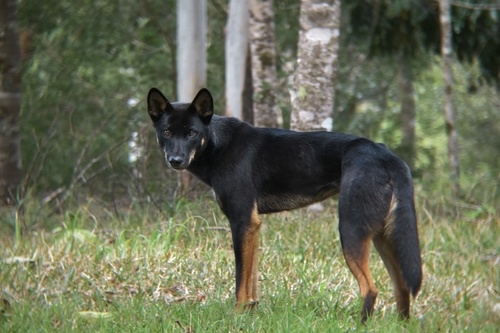
Domestic Dog
Canis familiaris
The world's most diverse mammal and our oldest companion, the domestic dog is a master of adaptation. From tiny lap dogs to massive guardians, these intelligent canines bring a lively energy to every backyard they visit.
Quick Identification
Size
Extremely variable; 15–110 cm (6–43 in) at shoulder, weighing 1–100 kg (2–220 lbs)
Colors
Highly diverse including black, white, brown, tan, gold, and grey; patterns include brindle, spotted, merle, and solid
Key Features
- Non-retractable claws on padded paws
- Highly expressive ears that may be erect, floppy, or cropped
- Variable muzzle length from flat-faced to long and pointed
- Tail shapes ranging from tightly curled to long and bushy
When You’ll See Them
Sightings on EverydayEarth
May 2, 2026
A black and white domestic dog is seen sniffing the grass in a clearing before trotting purposefully across the field and out of view to the right.
Jul 25, 2026
A group of White Rhinoceroses is resting in a fenced woodland enclosure at night. Most of the rhinos are lying on the ground sleeping, while one individual stands near the left side, occasionally shifting its weight and moving its head. A domestic dog is also visible, curled up and asleep in the bottom-left corner of the enclosure.
Jul 22, 2026
A group of three rhinoceroses are resting on the ground in a clearing under some trees. In the foreground, two domestic dogs are also resting; one is curled up in a tight ball sleeping, while the other is lying down with its head up, occasionally looking around.
Jul 21, 2026
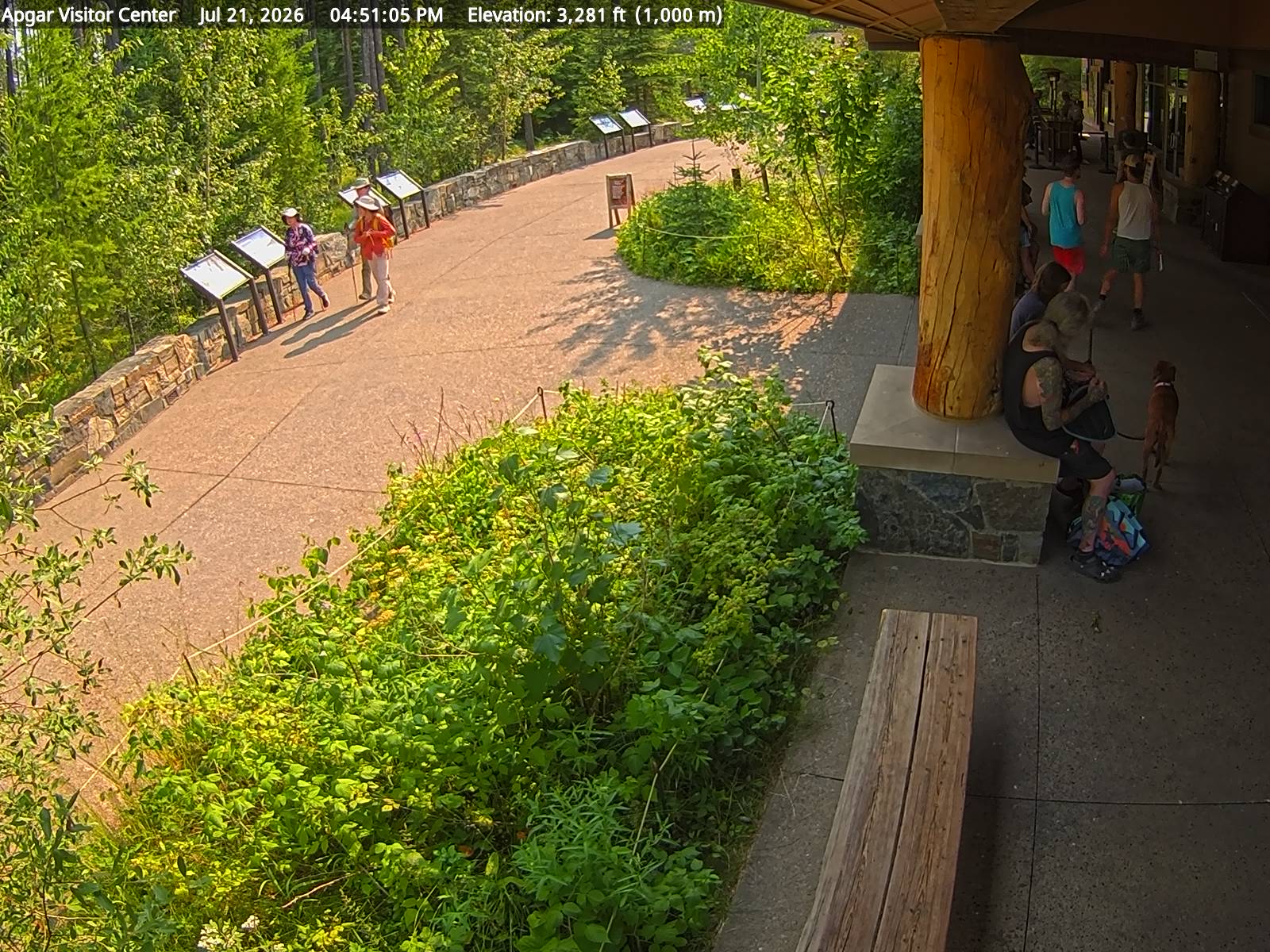
A visitor sits on a stone ledge with a reddish-brown domestic dog on a leash in the plaza of the Apgar Visitor Center. Several other people are visible nearby, walking and observing informational displays on a bright, sunny afternoon.

Jul 21, 2026
A bright, sunny afternoon at the Apgar Visitor Center plaza. Several visitors are gathered near the stone wall and informational kiosks. A light-colored domestic dog is being walked along the paved walkway by its owner.

Jul 16, 2026
A bright, sunny afternoon at the Apgar Visitor Center plaza. Several visitors are present, some walking along the path and others reading informational signs. In the foreground, a person is seated on a bench petting a small tan dog.
Geographic range
Where Does the Domestic Dog Live?
Domestic dogs are truly global citizens, having followed human migration to every corner of the earth. Originally descended from gray wolves in Eurasia, they now thrive on every continent except Antarctica. They are found in the highest densities across North America, Europe, and Asia, living in virtually every environment from high-altitude mountain villages to tropical coastal towns.
Basemap © OpenStreetMap contributors
Recorded on EverydayEarth
Behavior
Domestic dogs are arguably the most socially intelligent animals in our backyards. Having evolved alongside humans for over 15,000 years, they possess a unique ability to interpret human gestures, vocal tones, and even emotional states. Their behavior is a blend of ancestral pack instincts and highly refined domestic traits, often manifesting as territorial patrolling, playful 'zoomies,' and complex scent-marking rituals.
In a backyard setting, dogs are typically active in bursts, often synchronized with their owners' schedules. They spend a significant amount of time using their highly developed sense of smell to 'read' the local news left behind by other animals. While most are friendly, their interactions with local wildlife can range from curious observation to predatory chasing, depending on their breed-specific prey drive and training.
EverydayEarth exclusive
Camera Tips
When setting up your AI-powered camera to capture the antics of neighborhood dogs, mounting height is your most important variable. For the best view of a dog's facial expressions and gait, aim for 'snoot level'—roughly 18 to 24 inches off the ground. If you have a wide variety of breeds in your area, ranging from Chihuahuas to Great Danes, a slightly higher mount angled downward at 15 degrees will ensure you don't miss the smaller visitors while still capturing the full profile of the larger ones.
Dogs are incredibly scent-oriented. To encourage a dog to stop and pose for a clear photo, you don't necessarily need food bait. Often, a 'novel' scent—such as a small amount of diluted essential oil or even a new piece of garden furniture—will prompt them to pause and sniff, giving the camera time to trigger. Be aware that many dogs are territorial; placing your camera near a fence line or a known 'marking' spot like a large rock or post will yield the most frequent captures.
Because dogs can move with sudden, explosive speed, your camera settings are crucial. Prioritize a fast trigger speed (under 0.5 seconds if possible) to avoid 'ghost' images or shots of just a retreating tail. High-definition video mode is particularly rewarding for this species, as it captures social behaviors like 'play bows' or the tilt of a head when they hear the camera's shutter. If using a flash at night, try to use 'no-glow' infrared to avoid startling the animal or alerting them to the camera's presence.
Similar Species
Species that look similar or are commonly confused with Domestic Dog.
Coyote
Coyotes have a more slender build, bushier tails held downwards, and more pointed muzzles than most dog breeds.
Gray Wolf
Wolves are significantly larger with much bigger paws and a more blocky head shape compared to even the largest domestic dogs.
Red Fox
Foxes are much smaller, have characteristic black 'stockings' on their legs, and move with a cat-like grace unlike the sturdier trot of a dog.
Frequently Asked Questions
Record Domestic Dog at your habitat
Connect a camera to start building your own species record — AI identifies every visitor automatically.