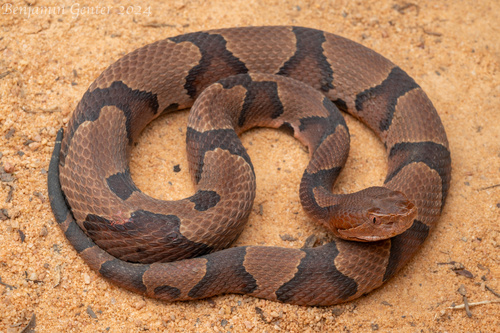
Eastern Copperhead
Agkistrodon contortrix
A master of disguise with a stunning hourglass pattern, the Eastern Copperhead is the most common pit viper found in Eastern American backyards.
Quick Identification
Size
61–91 cm (24–36 inches) in length; rarely exceeding 1.2 m (4 feet). Weight typically ranges from 100–350g (3.5–12 oz).
Colors
Pale tan to pinkish-brown base color with darker brown, hourglass-shaped crossbands; juveniles have a bright sulfur-yellow tail tip.
Key Features
- Hourglass-shaped crossbands (narrow at the spine, wide at the sides)
- Broad, spade-shaped copper-colored head
- Vertical, cat-like pupils
- Deep heat-sensing pits between the eyes and nostrils
- Stocky, heavy-bodied build
When You’ll See Them
Geographic range
Where Does the Eastern Copperhead Live?
Native to the North American continent, the Eastern Copperhead is found across a massive portion of the eastern and central United States. Its range extends from southern New England and the Mid-Atlantic states southward to the Florida Panhandle and westward to the edge of the Great Plains in Texas and Oklahoma. While they are most abundant in the Appalachian highlands and the Piedmont region, they are remarkably adaptable and are frequently found in the greenbelts and wooded backyards of major suburban areas.
Basemap © OpenStreetMap contributors
Behavior
The Eastern Copperhead is a master of camouflage, relying on its 'dead leaf' pattern to remain undetected by both predators and prey. Unlike many snakes that flee when approached, the copperhead's primary defense is to remain perfectly still. This 'freeze' response is why many human encounters occur—people simply don't see the snake until they are very close. While they are venomous pit vipers, they are generally non-aggressive and will typically only strike if stepped on or directly provoked.
These snakes exhibit interesting seasonal behavior shifts. In the cool spring and autumn months, they are primarily diurnal, basking in the sun to regulate their body temperature. However, during the sweltering heat of mid-summer, they become almost entirely nocturnal, hunting for prey under the cover of darkness. They are also known to be somewhat social during hibernation, often sharing winter dens (hibernacula) with other snake species like timber rattlesnakes and black racers.
EverydayEarth exclusive
Camera Tips
Capturing an Eastern Copperhead on camera requires a strategic approach because they are cold-blooded. Most trail cameras use Passive Infrared (PIR) sensors that trigger based on heat and motion; however, a snake's body temperature often matches the surrounding ground, making it 'invisible' to the sensor. To combat this, place your camera very low to the ground (within 6-12 inches) and angle it across a known travel path, such as the edge of a log or the base of a stone wall, where the physical movement is more likely to trigger the sensor.
For the best results, use 'Time Lapse' mode if your camera supports it. Set the camera to take a photo every 30 to 60 seconds during the evening hours of July and August. This bypasses the PIR sensor entirely and is the most reliable way to catch a copperhead as it slowly prowls for prey. Focus your efforts on 'structural funnels' like fallen timber, rock piles, or the transition zone between a manicured lawn and a wooded area.
Safety is paramount when checking cameras in copperhead territory. Always wear snake-proof boots or gaiters and use a long stick or a 'snake hook' to clear debris around your camera before reaching for it. Never place your hands where you cannot see, especially under the camera mount or near rock crevices. If you see a copperhead on your footage, look for nearby features like large flat rocks; these are likely basking spots where you can reliably capture more activity throughout the season.
Frequently Asked Questions
Record Eastern Copperhead at your habitat
Connect a camera to start building your own species record — AI identifies every visitor automatically.