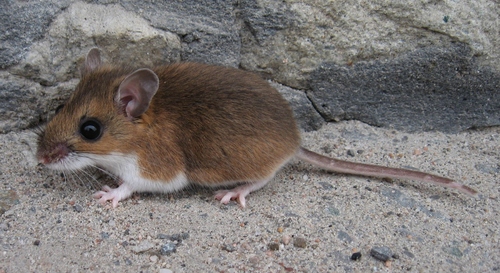
Eastern Deer Mouse
Peromyscus maniculatus
A wide-eyed acrobat of the night, the Eastern Deer Mouse is a master of the forest floor and tree canopy alike. Recognizable by its crisp white 'stockings' and large, soulful eyes, this industrious rodent is a vital part of the North American ecosystem.
Quick Identification
Size
Total length: 12–20 cm (4.7–7.9 in); Tail length: 4–10 cm (1.6–3.9 in); Weight: 10–25 g (0.35–0.88 oz)
Colors
Tawny to grayish-brown upper body with a stark, crisp white underbelly and white feet. Juveniles are typically a uniform dusky gray before their first molt.
Key Features
- Large bulging black eyes adapted for night vision
- Oversized thinly furred ears
- Distinctly bicolored tail with a dark top and white underside
- Pure white 'stocking' feet and white belly
When You’ll See Them
Geographic range
Where Does the Eastern Deer Mouse Live?
The Eastern Deer Mouse is native to the North American continent, occupying a vast territory across the eastern half of the region. Its range extends from central Canada through the Great Lakes and across the United States east of the Mississippi River, though it is generally absent from the humid lowland coastal plains of the Deep South. They are one of the most widespread small mammals in the temperate forests and rural landscapes of the Northeast and Midwest.
Basemap © OpenStreetMap contributors
Behavior
The Eastern Deer Mouse is a highly agile and energetic nocturnal rodent. Unlike the common house mouse, this species is an exceptional climber, frequently ascending trees and shrubs to forage for seeds or to escape predators. They are known for their 'drumming' behavior, where they rapidly tap their front paws on a hollow log or dry leaf when they feel threatened or agitated.
During the autumn months, these mice become frantic workers, gathering and caching large quantities of seeds, nuts, and grain in hidden hollows or underground burrows to survive the winter. While they are mostly solitary, they are known to huddle together in communal nests during extreme cold to share body heat, a behavior that helps them remain active year-round even in snowy climates.
EverydayEarth exclusive
Camera Tips
To successfully capture the Eastern Deer Mouse on your backyard camera, placement is everything. These mice almost always travel along 'structural leads'—linear features like the edges of garden fences, fallen logs, or the foundations of sheds. Position your camera just 6 to 10 inches off the ground, angled slightly downward toward the base of a tree or a woodpile. Because they are small and fast, a camera with a high trigger speed (under 0.3 seconds) is essential to avoid capturing just a 'ghost' or a tail.
Since they are strictly nocturnal, your camera's infrared (IR) performance is critical. We recommend using a 'No-Glow' IR flash to ensure the mouse doesn't get spooked, although they are generally less flighty than larger mammals. To keep them in the frame for more than a split second, use a 'lure' such as a smear of peanut butter on a rock or a small pile of black-oil sunflower seeds. Place the bait exactly where your camera's focus is sharpest, typically 3-5 feet from the lens.
For the best results, use video mode rather than still photos. A 10-15 second video clip will capture their fascinating grooming habits, their nervous 'scanned' movements, and their incredible leaping ability. If you are using a trail camera in a wooded area, look for 'runways' in the leaf litter or small holes at the base of stumps, as these are high-traffic zones for these industrious rodents.
Similar Species
Species that look similar or are commonly confused with Eastern Deer Mouse.
White-footed Mouse
Nearly identical in appearance; white-footed mice generally have slightly smaller ears and shorter tails, and they prefer more forested habitats than the adaptable deer mouse.
House Mouse
Lacks the white belly and feet; has a uniform grayish-brown coat and much smaller eyes and ears.
Frequently Asked Questions
Record Eastern Deer Mouse at your habitat
Connect a camera to start building your own species record — AI identifies every visitor automatically.