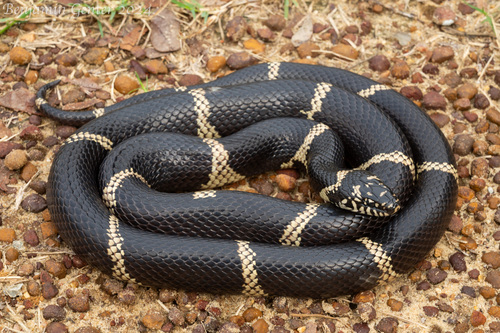
Eastern Kingsnake
Lampropeltis getula
The legendary 'King' of the backyard, this glossy black constrictor is a gardener's best friend. Famous for its chain-link pattern and its ability to eat venomous snakes, the Eastern Kingsnake is a master of the undergrowth.
Quick Identification
Size
36-48 inches (90-122 cm) average, with record lengths up to 82 inches (208 cm); weight typically 1.5-3.5 lbs (0.7-1.6 kg)
Colors
Glossy black or dark chocolate-brown body with narrow white or cream-colored crossbands that connect along the sides in a chain-like pattern; bellies are usually checkered black and white.
Key Features
- Glossy black body with white or yellow chain-link markings
- Smooth, polished scales that shine in sunlight
- Small head slightly wider than the neck with a blunt snout
- Checkered or blotched black and white belly
When You’ll See Them
Geographic range
Where Does the Eastern Kingsnake Live?
The Eastern Kingsnake is native to the North American continent, specifically localized within the Eastern United States. Its core range extends from southern New Jersey down through the Atlantic Coastal Plain to the tip of Florida, and westward into the Appalachian Mountains and parts of Alabama and Mississippi. While it is a common resident across the Southeast, populations are most dense in the moist, lowland regions of the Atlantic and Gulf coastal plains.
Basemap © OpenStreetMap contributors
Behavior
The Eastern Kingsnake is a powerful constrictor renowned for its docility toward humans but its ferocity toward other snakes. It earned the name 'King' due to its ability to hunt and consume other snake species, including venomous ones like Copperheads and Rattlesnakes, thanks to a natural immunity to their venom. Despite this predatory prowess, they are generally shy and will attempt to flee or hide when encountered by people.
When threatened and unable to escape, they may vibrate their tails rapidly in dry leaves to mimic a rattlesnake or emit a foul-smelling musk to deter predators. In the cooler months of spring and fall, they are primarily active during the day (diurnal), but as the summer heat intensifies, they often shift their activity to the cooler hours of dawn, dusk, or even nighttime to avoid overheating.
EverydayEarth exclusive
Camera Tips
To capture an Eastern Kingsnake on a backyard camera, placement is everything. These snakes are ground-dwellers that prefer 'edge' habitats where they can quickly slip into cover. Position your camera just a few inches off the ground near fallen logs, brush piles, or along the foundation of an outbuilding. Because they are cold-blooded, traditional PIR (Passive Infrared) motion sensors may struggle to trigger; use a camera with a high-sensitivity setting or set it to 'Time Lapse' mode with 30-second intervals during the morning hours.
Focus your efforts on areas where their prey hangs out. A camera pointed at a known lizard basking spot or near a bird feeder (where rodents gather) is a prime location for a hunting Kingsnake. Look for 'corridors' like the gap between a garden fence and a flower bed, as snakes often travel along vertical structures to stay hidden from hawks and other aerial predators.
Seasonality plays a major role in camera success. In the early spring (April and May), male Kingsnakes are on the move searching for mates, making this the best time to see them crossing open patches. During the height of summer, shift your camera's focus to shaded, damp areas near water or thick mulch piles, as the snakes will be seeking cooler microclimates to regulate their body temperature.
Frequently Asked Questions
Record Eastern Kingsnake at your habitat
Connect a camera to start building your own species record — AI identifies every visitor automatically.