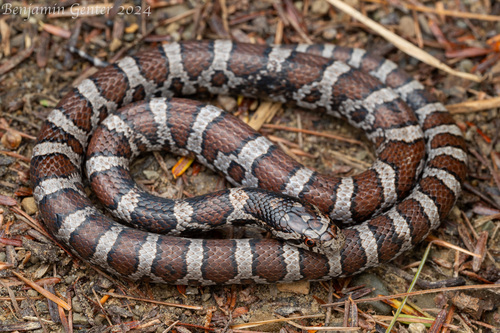
Eastern Milksnake
Lampropeltis triangulum
A master of disguise and a friend to gardeners, the Eastern Milksnake is a stunning, non-venomous constrictor often found patrolling backyard stone walls and woodpiles for pests.
Quick Identification
Size
24-36 inches (61-91 cm) in length; maximum recorded length is approximately 52 inches (132 cm)
Colors
Grey or tan base color with large, reddish-brown or chocolate-colored blotches outlined in black. Features a distinct black and white checkered belly.
Key Features
- Light-colored 'Y' or 'V' shaped mark on the back of the head
- Three rows of dark, black-bordered blotches
- Smooth, shiny scales with a cylindrical body
- Checkered black-and-white belly pattern
When You’ll See Them
Geographic range
Where Does the Eastern Milksnake Live?
The Eastern Milksnake is native to North America, spanning a wide territory from southeastern Canada through the Eastern United States. Its core range extends from Maine and southern Quebec down through the Appalachian Mountains and as far west as the Great Lakes region and the Mississippi River. These adaptable reptiles are common residents in both rural wilderness and established suburban neighborhoods across the Northeast and Midwest.
Basemap © OpenStreetMap contributors
Behavior
Eastern Milksnakes are secretive, solitary hunters that are primarily active at night or during the twilight hours of dawn and dusk. Despite their fearsome reputation among some homeowners, they are non-venomous and generally docile. When threatened, they may vibrate their tails rapidly against dry leaves, creating a buzzing sound that mimics a rattlesnake to ward off predators.
As members of the kingsnake family, they are powerful constrictors. They spend much of their time hidden under cover—such as logs, rocks, or loose bark—to regulate their body temperature and avoid detection. In suburban environments, they are often found near old stone walls or in the cool, damp corners of basements and barns where prey is abundant.
EverydayEarth exclusive
Camera Tips
To capture an Eastern Milksnake on camera, placement is everything. These snakes are highly terrestrial and rarely lift their bodies far off the ground, so you must position your camera just a few inches above the soil. Aim the lens toward 'travel corridors' where they are likely to move, such as the edge of a stone wall, the base of a building foundation, or along a large fallen log. A wide-angle lens setting is preferable to catch their full length as they glide past.
Since milksnakes are primarily crepuscular or nocturnal during the heat of summer, ensure your camera has a high-quality infrared (no-glow) flash that won't startle them. Set your trigger speed to the fastest possible setting; while they aren't as fast as a mammal, their sleek bodies can move through a frame surprisingly quickly. Using 'Burst Mode' for stills or short video clips (10-15 seconds) is significantly more effective than a single photo, as the movement helps confirm identification and reveals their unique belly patterns.
You can encourage a visit by creating a 'habitat station.' Place a flat piece of plywood or a large, flat basking rock in a spot that receives partial sun near cover; snakes use these to thermoregulate. If you place your camera to monitor the edge of this cover, you are likely to catch them as they emerge in the evening. Avoid using artificial baits, as snakes hunt by scent and movement; instead, focus your camera on areas with high rodent activity, which will naturally attract these predators.
Frequently Asked Questions
Record Eastern Milksnake at your habitat
Connect a camera to start building your own species record — AI identifies every visitor automatically.