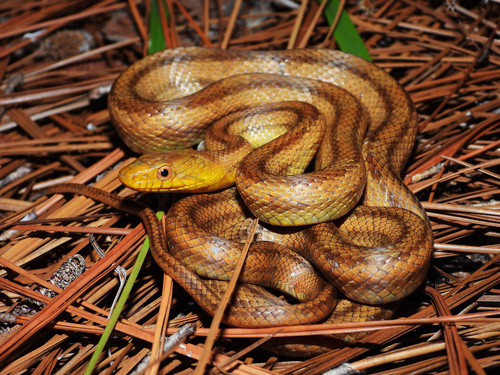
Eastern Ratsnake
Pantherophis quadrivittatus
The Eastern Ratsnake is a striking, golden-hued climber native to the American Southeast. Known for its incredible ability to scale trees and its role as a master pest controller, it is one of the most fascinating reptiles to discover in a backyard habitat.
Quick Identification
Size
3 to 6 feet (91–183 cm) in length; weight typically 1 to 4 lbs (0.5–2 kg)
Colors
Golden-yellow, tan, or greenish-yellow base with four prominent dark brown longitudinal stripes
Key Features
- Four dark longitudinal stripes running the length of the body
- Slender build with a 'loaf of bread' cross-section
- Yellow to tan ground color
- Highly agile climber
When You’ll See Them
Geographic range
Where Does the Eastern Ratsnake Live?
Native to the North American continent, the Eastern Ratsnake is a specialist of the Atlantic Coastal Plain. Its core range spans from southeastern North Carolina down through South Carolina and Georgia, encompassing nearly the entirety of the Florida peninsula. These snakes thrive in the humid, lowland environments of the American Southeast and are commonly encountered in both wild wetlands and developed suburban landscapes.
Basemap © OpenStreetMap contributors
Behavior
Eastern Ratsnakes are renowned for their agility and versatility. While they are often found on the ground, they are exceptionally skilled climbers, frequently found high in the canopy of trees or tucked into the rafters of barns. They are primarily active during the day, though they may shift to more crepuscular or even nocturnal activity during the hottest summer months to regulate their body temperature.
As nonvenomous constrictors, they are highly beneficial to humans because they provide excellent natural pest control. When threatened, they may kink their bodies to resemble a fallen branch or vibrate their tails in dry leaves to mimic a rattlesnake. While they may act defensively if cornered—hissing or striking to deter a predator—they are generally shy and prefer to retreat into hollow logs or tree cavities.
EverydayEarth exclusive
Camera Tips
To capture the Eastern Ratsnake, you must think vertically. Unlike many ground-dwelling snakes, these serpents are master climbers. Mount your camera 3 to 5 feet off the ground, angled slightly downward toward a prominent horizontal branch, a fence rail, or the top of a stone wall. These snakes often use these elevated 'highways' to navigate through backyards and gardens while staying safe from ground predators.
Since snakes are ectothermic, they don't always trigger the Passive Infrared (PIR) sensors used by most trail cameras. To improve your chances, set your camera to 'Time Lapse' mode during the morning hours (8 AM to 11 AM) when they are most likely to be basking or hunting. Focus your lens on sun-drenched patches of ivy or woodpiles, as these snakes often pause in the sun to warm their bodies before becoming active.
If you are looking for a specific location, place your camera near a bird feeder or a compost pile. While the snake isn't interested in the seeds or scraps, it is highly attracted to the rodents and small birds that frequent these areas. Ensure your camera is set to a high-sensitivity trigger if available, and use a fast shutter speed to capture their fluid, flickering tongues and steady movement.
Frequently Asked Questions
Record Eastern Ratsnake at your habitat
Connect a camera to start building your own species record — AI identifies every visitor automatically.