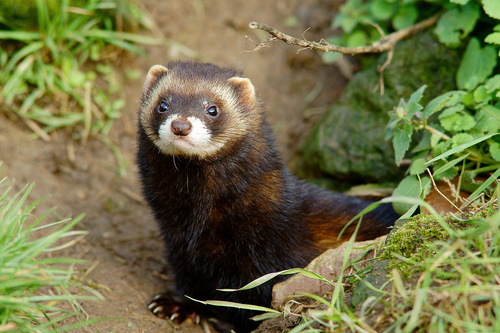
European Polecat
Mustela putorius
A mysterious nocturnal hunter of the European countryside, the European Polecat is the wild ancestor of the domestic ferret, recognized by its striking bandit mask and pungent personality.
Quick Identification
Size
Body length 35–46 cm (14–18 in); Tail 11–17 cm (4–7 in); Weight 0.7–1.5 kg (1.5–3.3 lb)
Colors
Dark brown outer coat with yellowish-white underfur; white patches on the muzzle and ear tips; dark facial mask across the eyes
Key Features
- Dark 'bandit mask' across the eyes
- Yellowish-buff underfur visible through dark guard hairs
- Short, stocky build compared to weasels
- Round, white-tipped ears
When You’ll See Them
Geographic range
Where Does the European Polecat Live?
Native to the European continent, the European Polecat thrives across a broad territory reaching from the British Isles and Western Europe all the way to the Ural Mountains in Russia. It is also found in the Rif Mountains of North Africa, representing the southern limit of its natural distribution. While it is absent from the most northern reaches of Scandinavia and certain Mediterranean islands, its population is currently expanding back into areas of the United Kingdom where it was previously near extinction.
Basemap © OpenStreetMap contributors
Behavior
The European Polecat is a solitary and primarily nocturnal carnivore known for its methodical hunting style. Unlike its smaller, more frantic cousins like the weasel, the polecat has a more powerful build and a slower, undulating gait. They are highly territorial and use potent scent glands near the tail to mark their range with a pungent, musky odor, which serves as both a deterrent to predators and a communication tool for other mustelids.
During the day, they typically retreat to dens in hollow logs, rock crevices, or abandoned rabbit burrows. While they are generally shy of humans, they are increasingly found on the outskirts of suburban areas where they take advantage of woodpiles and outbuildings. They are remarkably persistent hunters, often returning to the same location multiple nights in a row if they have identified a steady food source.
EverydayEarth exclusive
Camera Tips
To capture the European Polecat on camera, placement is everything. These animals are low-slung and tend to hug 'linear features' in the landscape. Position your camera just 10–20 cm (4–8 inches) off the ground, facing along the base of a hedgerow, a stone wall, or the edge of a garden fence. They often use these features as highways to navigate safely under cover.
Because polecats are strictly nocturnal, ensure your camera has a high-quality infrared flash that won't spook them. Video mode is highly recommended—set it to capture 15–20 second clips. This allows you to see their distinctive 'hump-backed' movement and the way their pale underfur flashes through their dark guard hairs, which is a key ID feature that can be missed in a single blurry still photo.
If you aren't seeing results, try using a scent lure rather than a physical bait. A rag soaked in sardine oil or even a small amount of strong-smelling cat food placed inside a perforated container will pique their curiosity. Place the lure about two meters in front of the camera. In winter, look for their tracks in the mud or snow—five-toed prints about 3-4cm wide—and aim your camera at any gaps in logs or woodpiles where they might be seeking warmth or hunting rodents.
Similar Species
Species that look similar or are commonly confused with European Polecat.
Frequently Asked Questions
Record European Polecat at your habitat
Connect a camera to start building your own species record — AI identifies every visitor automatically.