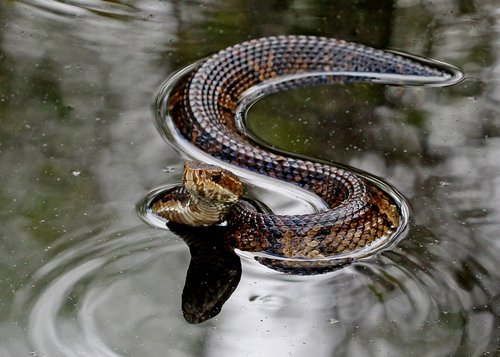
Florida Cottonmouth
Agkistrodon conanti
A powerful, heavy-bodied resident of the Southeast's wetlands, the Florida Cottonmouth is a master of the swamp. Recognizable by its 'cotton' white mouth and keeled scales, it is a vital predator in Florida's diverse aquatic ecosystems.
Quick Identification
Size
Typically 30 to 48 inches (76–122 cm) in length; large adults can reach 70 inches (178 cm). Weights range from 1 to 4.5 lbs (0.5–2 kg).
Colors
Dark olive, brown, or black with darker crossbands; belly is usually pale with dark blotches; juveniles are brighter with a sulfur-yellow tail tip.
Key Features
- Broad, triangular head distinct from the neck
- Dark horizontal 'mask' stripe running through the eye
- Vertical, cat-like pupils and heat-sensing pits
- Gaping defensive display revealing a white mouth lining
When You’ll See Them
Geographic range
Where Does the Florida Cottonmouth Live?
The Florida Cottonmouth is a native of the North American Southeast, with a range centered primarily within the Florida peninsula and extending into southern Georgia. It is found across nearly the entire state of Florida, including many of the offshore keys and barrier islands. While it is a lowland specialist common in the coastal plain, it thrives in almost any permanent or semi-permanent freshwater source within its subtropical range.
Basemap © OpenStreetMap contributors
Behavior
The Florida Cottonmouth is a semi-aquatic pit viper known for its stoic and often misunderstood temperament. Primarily a solitary creature, it spends a significant portion of its day basking on logs, rocks, or banks at the water's edge to regulate its body temperature. Unlike many snakes that flee at the first sign of trouble, the Cottonmouth often holds its ground. When threatened, it performs a famous defensive display: coiling its heavy body and opening its jaws wide to reveal the startling, snow-white lining of its mouth, a warning signal to potential predators.
While they are potent hunters with a complex hemotoxic venom, they are not naturally aggressive toward humans and typically only strike if stepped on or directly harassed. They are remarkably buoyant swimmers, often seen with their entire bodies floating high on the water's surface. During the breeding season, males may engage in ritualized combat, raising their forebodies and intertwining them in a test of strength to win the right to mate with nearby females.
EverydayEarth exclusive
Camera Tips
Capturing a Florida Cottonmouth on a trail camera requires focusing on the 'interface' between land and water. These snakes are creatures of habit and often use the same logs or muddy flat spots for basking. Position your camera about 6 to 12 inches off the ground, aiming parallel to the shoreline. Look for sunny spots near slow-moving water or swamp margins. Because snakes are ectotherms, they may not always trigger a standard Passive Infrared (PIR) sensor if their body temperature matches the background; use a camera with a 'Time Lapse' mode or set your sensor to high sensitivity to increase your chances of a trigger.
Nighttime is often more productive for seeing active hunting behavior, especially during humid summer nights or immediately after a rainstorm. Ensure your camera's infrared flash is not too close to the subject, as the reflective scales of a Cottonmouth can easily 'white out' in night photos, obscuring the beautiful crossband patterns. A video setting of 10–20 seconds is highly recommended over still photos, as it captures the snake's deliberate movements and characteristic tongue-flicking, which is used to 'smell' the environment.
Safety is paramount when working in Cottonmouth territory. Never place a camera in thick vegetation where you cannot see your feet, and always wear snake-proof boots when checking your equipment. Use a long stick to clear any debris around the camera before reaching for it. If you are placing a camera in a backyard near a canal, look for areas where the grass meets the water's edge, as these are natural corridors for snakes moving between hunting grounds.
Frequently Asked Questions
Record Florida Cottonmouth at your habitat
Connect a camera to start building your own species record — AI identifies every visitor automatically.