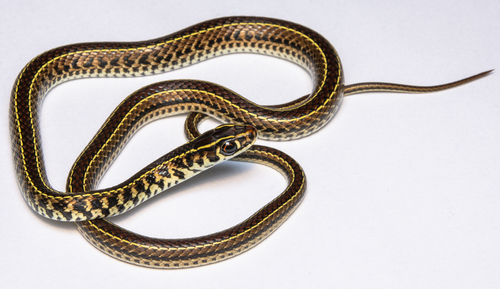
Fronted Ground Snake
Lygophis flavifrenatus
An elegant, striped resident of South American wetlands, the Fronted Ground Snake is a harmless hunter known for its striking facial 'bridle' and lightning-fast movements.
Quick Identification
Size
50–75 cm (20–30 inches) in length; lightweight and slender build
Colors
Olive-brown or tan base with four dark longitudinal stripes; distinctive yellow or cream 'bridle' markings on the snout and face
Key Features
- Distinctive yellow or cream stripes on the head and snout
- Four dark brown or black stripes running the length of the body
- Slender body with a narrow, pointed head
- Large eyes with round pupils and a golden iris
When You’ll See Them
Geographic range
Where Does the Fronted Ground Snake Live?
The Fronted Ground Snake is a native inhabitant of the central-southern regions of South America. Its core range spans the vast grasslands and wetlands of Southern Brazil, Uruguay, and Northern Argentina, extending through the humid plains of Paraguay. It is a common sight in the Pampas biome, where the combination of seasonal rainfall and temperate weather provides the ideal conditions for its primary prey.
Basemap © OpenStreetMap contributors
Behavior
The Fronted Ground Snake is a diurnal species, meaning it is most active during the daylight hours when it can use the sun's warmth to regulate its body temperature. It is a terrestrial hunter, frequently observed navigating through tall grass or near the edges of water bodies. Despite its alert nature, it is generally shy and will quickly retreat into thick vegetation if it perceives a threat. It is non-venomous and poses no danger to humans or pets.
Socially, these snakes are solitary, coming together only during the breeding season. They are highly efficient foragers, often seen flicking their tongues to pick up chemical cues from the environment. In suburban settings, they are beneficial neighbors as they help control populations of small pests and amphibians, though they are often misunderstood due to their quick movements.
EverydayEarth exclusive
Camera Tips
To capture the Fronted Ground Snake on an AI-powered camera, placement is everything. These snakes are ground-dwellers that stick to 'edge' habitats. Position your camera along the transition zone between a manicured lawn and taller wild grass, or near the moist perimeter of a garden pond. Because they are slender and move low to the ground, mount your camera no higher than 10–15 centimeters (4–6 inches) off the ground, angled slightly downward to ensure the sensor picks up their movement.
Since these snakes are diurnal, focus your efforts on daylight capture. They are most active on warm, humid days, particularly immediately following a rain shower when frogs and toads are most active. If your camera has a high-sensitivity PIR (Passive Infrared) setting, use it; cold-blooded reptiles can sometimes be difficult for standard thermal sensors to trigger unless the snake has been basking and is warmer than the surrounding soil.
Fast trigger speeds are essential. The Fronted Ground Snake is a 'widely foraging' predator, meaning it moves constantly while hunting rather than waiting in ambush. Use a burst mode of 3–5 photos to ensure you get a clear shot of the head markings, which are vital for positive identification. In backyard settings, providing 'stepping stones' or flat pieces of wood near water can create basking spots that encourage the snake to pause in front of your lens.
Frequently Asked Questions
Record Fronted Ground Snake at your habitat
Connect a camera to start building your own species record — AI identifies every visitor automatically.