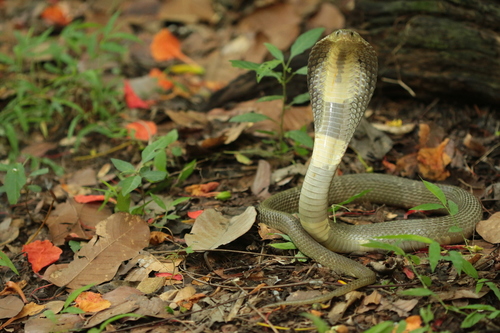
Indochinese Spitting Cobra
Naja siamensis
A master of chemical defense, the Indochinese Spitting Cobra is a striking and highly adaptable resident of Southeast Asian gardens and forests. Known for its ability to 'spit' venom with pinpoint accuracy, this nocturnal hunter is a vital part of the ecosystem's natural pest control.
Quick Identification
Size
0.9 to 1.2 meters (3 to 4 feet) on average; maximum length up to 1.5 meters (5 feet).
Colors
Highly variable; can be solid black, grey, or brown, but often features a striking black-and-white spotted or 'salt and pepper' pattern.
Key Features
- Expansible neck hood with variable markings
- Capable of spraying venom accurately up to 3 meters
- Smooth, glossy dorsal scales
- Large eyes with round pupils
When You’ll See Them
Geographic range
Where Does the Indochinese Spitting Cobra Live?
The Indochinese Spitting Cobra is native to the Indochina region of Southeast Asia. Its core range encompasses much of Thailand, Cambodia, Laos, and Vietnam, where it thrives in a variety of low-lying environments. While it prefers natural scrublands and forest edges, it has become increasingly common in human-altered landscapes, including rice paddies and village outskirts where prey is plentiful.
Basemap © OpenStreetMap contributors
Behavior
The Indochinese Spitting Cobra is a primarily nocturnal and crepuscular species, meaning it is most active from dusk through the night. While it is a capable hunter of rodents and other small vertebrates, it is most famous for its specialized defensive mechanism. Unlike many other cobras that rely solely on a bite, this species can squeeze its venom glands to spray toxins through forward-facing holes in its fangs, targeting the eyes of perceived threats to cause immediate pain and temporary blindness.
In social terms, these snakes are solitary and generally avoid human contact whenever possible. They are not naturally aggressive and will typically attempt to flee if they sense vibrations from approaching footsteps. However, if cornered, they will raise the anterior third of their body, spread their iconic hood, and hiss loudly as a final warning before deploying their venom spray or delivering a defensive bite.
EverydayEarth exclusive
Camera Tips
To capture the Indochinese Spitting Cobra on an AI-powered camera, you should focus on 'travel corridors'—the narrow spaces between garden walls, woodpiles, or dense shrubbery. These snakes are highly terrestrial and prefer to move along edges rather than crossing open ground. Place your camera very low to the ground, no more than 15-20 centimeters high, and angle it parallel to a wall or fence line where the snake is likely to glide past.
Because this species is almost exclusively nocturnal, your camera’s infrared (IR) performance is critical. Use a 'no-glow' or 'black IR' flash to ensure the light doesn't startle the snake or cause it to move out of frame too quickly. High-sensitivity PIR (passive infrared) settings are recommended, as cold-blooded reptiles may not always trigger sensors as easily as warm-blooded mammals unless there is a significant temperature difference between the snake and the ground.
If you are looking to attract one to a specific spot for a clear ID, focus on its prey. Maintaining a bird feeder or a compost pile that naturally attracts mice and rats will indirectly bring cobras into the area. During the dry season, a shallow ground-level water dish can also be an irresistible draw for a thirsty cobra. Always remember to maintain a safe distance when servicing cameras in known cobra habitats, and never approach a snake that has been flagged by your AI system.
Frequently Asked Questions
Record Indochinese Spitting Cobra at your habitat
Connect a camera to start building your own species record — AI identifies every visitor automatically.