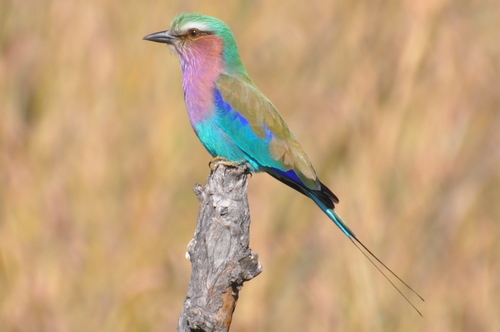
Lilac-breasted Roller
Coracias caudatus
Widely considered one of the most beautiful birds in the world, the Lilac-breasted Roller is a kaleidoscope of color. Often seen perched on the highest branches of the African savanna, this bold hunter is as famous for its aggressive defense of its nest as it is for its stunning plumage.
Quick Identification
Size
Length: 36–38 cm (14–15 in); Wingspan: 50–58 cm (20–23 in); Weight: 85–110 g (3–4 oz)
Colors
Pastel lilac throat and breast, turquoise underparts and wing coverts, olive-green back, and deep blue flight feathers. The face features a white forehead and a black line through the eye. Sexes are identical.
Key Features
- Pale lilac throat and breast
- Long, pointed outer tail streamers in adults
- Brilliant turquoise and azure wings visible in flight
- Large head with a heavy, black hooked beak
When You’ll See Them
Sightings on EverydayEarth
Jul 26, 2026
A Lilac-breasted Roller is perched on a branch within a thicket of trees. The bird remains alert, occasionally turning its head to observe the surrounding woodland.
Jun 20, 2026
A colorful Lilac-breasted Roller is perched on a gnarled acacia branch. The bird remains mostly stationary, occasionally turning its head to survey the surrounding woodland as the camera zooms in to provide a closer view.
Jun 18, 2026
A Lilac-breasted Roller is perched on a dead branch in the middle of a sunny woodland. The bird remains alert, turning its head to scan the environment for potential prey or predators, showcasing its bright, multi-colored feathers.
Jun 17, 2026
A Lilac-breasted Roller perches alertly on a dead branch. It turns its head several times to survey the surrounding woodland, showcasing its characteristic colorful plumage and sentinel behavior.
Jun 9, 2026
A vibrant Lilac-breasted Roller is perched on a piece of dead wood in a grassy woodland clearing. It remains relatively still, occasionally turning its head to scan the ground for potential prey like insects or small reptiles.
May 26, 2026
A Lilac-breasted Roller perches prominently on a weathered branch. It stays relatively still while scanning its surroundings, occasionally turning its head and briefly opening its beak as if calling.
Geographic range
Where Does the Lilac-breasted Roller Live?
The Lilac-breasted Roller is a crown jewel of the African continent, primarily found throughout Eastern and Southern Africa. Its core range extends from Ethiopia and Somalia through Kenya, Tanzania, and Zambia, down into Namibia, Botswana, and the northern parts of South Africa. While they are a quintessential African species, they are also found as residents or vagrants in the southern portion of the Arabian Peninsula, including Yemen and Oman.
Basemap © OpenStreetMap contributors
Recorded on EverydayEarth
Behavior
During the breeding season, these birds are famous for their spectacular aerial courtship displays, which gave the 'Roller' family its name. The male will fly to a great height and then plummet toward the earth in a series of side-to-side rolls, dives, and swoops, all while emitting loud, raucous cries. They are extremely territorial and will aggressively chase away much larger birds, including hawks and eagles, from their nesting sites.
While they are generally solitary or found in pairs, they are not particularly shy of humans and are frequently seen along roadsides in national parks and rural areas. They have a symbiotic relationship with bushfires, often perching on the edge of the smoke to catch insects and small animals fleeing the flames.
EverydayEarth exclusive
Camera Tips
To capture high-quality images of a Lilac-breasted Roller, you must focus on their perching habits. These birds are creatures of habit and will often return to the same high branch or fence post day after day to hunt. Mount your camera on a tripod or tree strap facing a prominent, isolated branch or a garden 'lookout' post. A distance of 3 to 5 meters (10–15 feet) from the perch is ideal for capturing their intricate feather patterns without spooking them.
Because they are most active during the 'Golden Hours' of early morning and late afternoon, ensure your camera is positioned to take advantage of the sun behind you. This lighting will make their turquoise and lilac colors pop. Since they are lightning-fast when they dive for prey, use a camera with a fast trigger speed (under 0.2 seconds) and set it to 'Burst Mode' or 'Photo + Video.' This increases your chances of catching the moment they spread their wings, which is when their most vibrant blue feathers are visible.
If you are in a suburban or rural area within their range, you can attract them by keeping a 'wild' patch in your garden that supports large insects like grasshoppers and beetles. They are not attracted to traditional seed or fruit bird feeders, but they may visit a garden that has a high perch near a clear patch of ground where they can easily spot insects moving. Avoid using pesticides, as this removes their primary food source and can be toxic to them.
Similar Species
Species that look similar or are commonly confused with Lilac-breasted Roller.
Frequently Asked Questions
Record Lilac-breasted Roller at your habitat
Connect a camera to start building your own species record — AI identifies every visitor automatically.