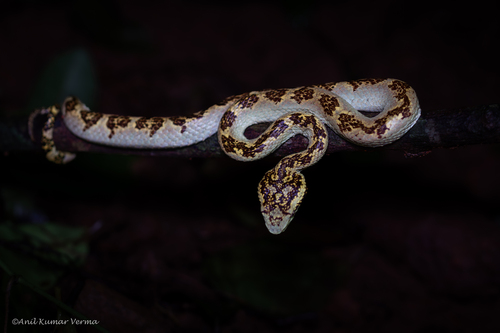
Malabarian Pit Viper
Craspedocephalus malabaricus
The Malabar Pit Viper is the 'chameleon' of the Western Ghats, sporting a breathtaking array of colors from lime green to burnt orange. Found only in the misty rainforests of India, this master of disguise is the ultimate prize for backyard naturalists and trail cam enthusiasts.
Quick Identification
Size
Total length typically 60–105 cm (24–41 inches); females are significantly larger and heavier than males.
Colors
Extremely polymorphic; individuals may be bright green, yellow, reddish-brown, or even violet-tinged, often with darker mottled patterns or zig-zags.
Key Features
- Distinct triangular head with heat-sensing pits
- Prehensile tail for anchoring to branches
- Highly variable coloration (polymorphism)
- Elliptical cat-like pupils
When You’ll See Them
Geographic range
Where Does the Malabarian Pit Viper Live?
Native to the continent of Asia, the Malabar Pit Viper is a prized endemic species found exclusively in the Western Ghats mountain range of southwestern India. Its core range spans the humid, high-elevation forests of states including Maharashtra, Goa, Karnataka, Tamil Nadu, and Kerala. Because it thrives in the mist-shrouded peaks and lush river valleys of this biodiversity hotspot, you won't find this unique serpent anywhere else on Earth.
Basemap © OpenStreetMap contributors
Behavior
The Malabar Pit Viper is a sluggish yet fascinating ambush predator. Unlike many snakes that actively forage, this species is known for its patience, often remaining coiled in the same spot for several days—or even weeks—waiting for prey to pass within striking distance. They are primarily nocturnal, becoming active as dusk falls to utilize their heat-sensing loreal pits to track warm-blooded prey in the dark.
While they are capable of moving through the leaf litter, they are semi-arboreal and frequently found perched on low-hanging branches, coffee bushes, or moss-covered rocks near forest streams. Interactions with humans are generally rare due to their camouflage, but they will strike if stepped on or agitated. Interestingly, they exhibit remarkable site fidelity, often returning to the same branch year after night.
EverydayEarth exclusive
Camera Tips
Capturing a Malabar Pit Viper on camera requires a different approach than mammal photography because snakes are ectothermic (cold-blooded). Most standard trail cameras rely on Passive Infrared (PIR) sensors that trigger when they detect a heat differential between an animal and the background. Since a resting viper often matches the ambient temperature, your camera may not 'see' it. To combat this, set your camera to 'Time Lapse' mode with a frequent interval (e.g., every 5-10 minutes) if you suspect a snake is using a specific perch.
Placement is everything for this species. Look for 'ambush spots' such as mossy rocks near small waterfalls or horizontal branches hanging over water. Mount your camera low—about 1 to 2 feet off the ground—and use a macro lens attachment if available, as these snakes are often stationary and can be framed beautifully. Angle the camera slightly downward to capture the intricate dorsal patterns which are key for identification.
The monsoon season (June to September) is the absolute best time for sightings, as the increased humidity and abundance of frogs bring these vipers out in high numbers. During this time, look for them on the edges of tea or coffee plantations adjacent to natural forests. Because they are nocturnal, ensure your camera has a high-quality 'no-glow' or 'low-glow' infrared flash to avoid overexposing the subject while capturing the detail of their scales. Avoid using traditional white flash as it can startle the animal and cause it to abandon a prime hunting spot.
Frequently Asked Questions
Record Malabarian Pit Viper at your habitat
Connect a camera to start building your own species record — AI identifies every visitor automatically.