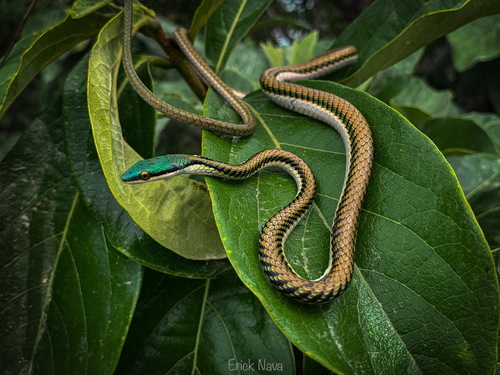
Mexican Parrot Snake
Leptophis mexicanus
A master of arboreal camouflage, the Mexican Parrot Snake is a vibrant, slender hunter that brings a touch of tropical elegance to any backyard canopy.
Quick Identification
Size
Typically 70–90 cm (28–35 in), but can reach up to 1.2 meters (4 ft)
Colors
Bright green to bronze dorsal scales, often with a darker lateral stripe; creamy white or yellowish belly
Key Features
- Extremely slender, whip-like body
- Prominent black stripe running through the eye
- Large, round pupils for daytime hunting
- Vivid bronze or green scales with dark edges
When You’ll See Them
Geographic range
Where Does the Mexican Parrot Snake Live?
The Mexican Parrot Snake is native to the tropical and subtropical regions of North and Central America. Its core range begins in the lowlands of eastern and western Mexico, extending south through the Yucatan Peninsula into Belize, Guatemala, Honduras, and El Salvador. It is a common resident across the humid corridors of Nicaragua and Costa Rica, where it thrives in both pristine wilderness and human-altered landscapes near sea level.
Basemap © OpenStreetMap contributors
Behavior
The Mexican Parrot Snake is a highly active, diurnal hunter that spends the majority of its life in the trees. Despite its intimidating appearance when threatened—it will open its mouth wide to reveal a dark interior in a defensive 'gaping' display—it is non-venomous and generally shy around humans. It relies on its incredible speed and camouflage to evade predators and ambush prey.
In a backyard setting, you will likely see this snake gracefully weaving through fence lines, hedges, or low-hanging branches. It is not a social species, preferring a solitary life where it can patrol its territory for small vertebrates. While it can bite if handled, it is considered harmless to humans and pets, making it a beneficial neighbor that keeps local pest populations in check.
EverydayEarth exclusive
Camera Tips
Capturing a Mexican Parrot Snake on camera requires a shift in perspective. Most trail camera users focus on the ground, but for this arboreal specialist, you should mount your camera 4 to 6 feet high. Aim the lens along horizontal branches, top rails of wooden fences, or the edges of dense hedgerows. These are the 'highways' the snake uses to traverse your yard while staying safe from ground predators.
Because these snakes are exceptionally fast and slender, they can sometimes fail to trigger standard PIR sensors. To increase your chances, set your camera to its most sensitive motion setting and use 'Burst Mode' or 'High-Speed Photo' settings. If your camera supports it, a shorter trigger interval is essential, as the snake may glide across the frame in less than two seconds. Position the camera at an angle to the branch (roughly 45 degrees) rather than perpendicular to it, which keeps the snake in the detection zone for a longer period.
Focus your efforts near water sources or bird feeders. While the snakes aren't interested in seeds, they are very interested in the lizards and frogs that congregate in these damp or insect-rich areas. A camera pointed at a birdbath or a cluster of broad-leafed plants like bromeliads or bananas is a prime spot. The best lighting will occur mid-morning when the sun hits the leaves, highlighting the iridescent bronze and green of their scales.
Frequently Asked Questions
Record Mexican Parrot Snake at your habitat
Connect a camera to start building your own species record — AI identifies every visitor automatically.