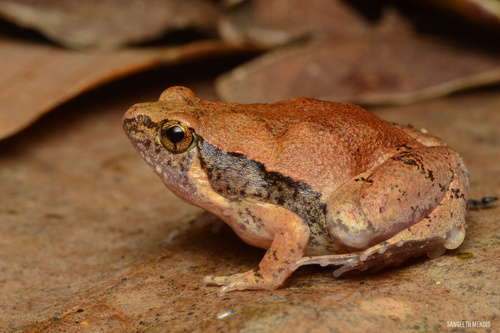
Mihintale Red Narrow-mouthed Frog
Microhyla mihintalei
An endemic jewel of Sri Lanka, the Mihintale Red Narrow-mouthed Frog is a master of the leaf litter. Small in size but bold in color, this specialist ant-eater emerges with the monsoon rains to transform dry gardens into vibrant nocturnal stages.
Quick Identification
Size
2.1 to 2.9 cm (0.8 to 1.1 inches) in length
Colors
Dorsal side is reddish-brown or orange-tan; creamy white or yellowish underbelly; dark brown lateral bands extending from the snout through the eye to the groin.
Key Features
- Distinct triangular head with a narrow, pointed snout
- Stocky, pear-shaped body with relatively short limbs
- Dark 'V' or 'X' shaped marking often present on the back
- Lacks a visible external ear membrane (tympanum)
- Small, bead-like black eyes
When You’ll See Them
Geographic range
Where Does the Mihintale Red Narrow-mouthed Frog Live?
This species is a proud endemic of South Asia, found only on the island of Sri Lanka. It is a specialist of the lowland dry zone, with a core range that covers the north-central, northern, and eastern parts of the country. While it was once confused with similar species on the Indian mainland, current research confirms it is restricted to the Sri Lankan landscape, where it thrives in both pristine forests and human-impacted rural gardens.
Basemap © OpenStreetMap contributors
Behavior
The Mihintale Red Narrow-mouthed Frog is a shy, terrestrial amphibian that spends the majority of its life hidden from view. During the dry season, it burrows into loose soil or hides deep within the damp leaf litter of Sri Lanka's dry zone forests and gardens. It is primarily nocturnal, emerging after sunset to hunt for tiny invertebrates. Because of its fossorial nature, it is rarely seen unless heavy rains draw it to the surface.
When the monsoon rains arrive, these frogs undergo a dramatic behavioral shift. They congregate in large numbers around ephemeral pools and flooded ditches for breeding. The males produce a distinctive, high-pitched chirping call that can be surprisingly loud for their small size. Despite their stocky appearance, they are agile jumpers, using quick, short leaps to escape predators like snakes and larger frogs.
In suburban settings, they are beneficial guests. They are frequently found in home gardens, especially those with plenty of mulch or organic ground cover. They do not interact directly with humans and are completely harmless, serving as an excellent natural form of pest control for gardens.
EverydayEarth exclusive
Camera Tips
Capturing a Mihintale Red Narrow-mouthed Frog on camera requires a dedicated 'macro' approach due to their diminutive size. Set your camera just 2 to 5 inches off the ground. A common mistake is placing cameras too high, which results in the frog appearing as a mere speck or being completely missed by the motion sensor. Use a wide-angle lens if possible to capture the surrounding environment while keeping the focus tight on the immediate foreground.
The best time to deploy your camera is during the first heavy rains of the monsoon. Look for low-lying areas in your backyard where water tends to pool temporarily. Placing the camera at the edge of a shallow puddle, angled slightly downward, is a high-reward strategy. These frogs congregate at water edges to breed, and the reflection of the frog in the water can make for a stunning photograph.
Since these frogs are strictly nocturnal, your camera’s infrared (IR) flash is essential. However, because their skin is moist, a standard IR flash can sometimes cause 'white-out' or glare. If your camera allows, set the flash intensity to 'low' or 'medium.' To attract them naturally, ensure there is a healthy layer of leaf litter or mulch in the frame; this provides them with the cover they need to feel safe enough to linger in front of the lens.
For the most professional results, use the 'burst mode' or 'photo+video' setting. These frogs move in quick, unpredictable hops. A single photo might catch a blurred limb, but a burst of three or five images increases your chances of getting a sharp, perfectly timed shot of the frog in a seated position. If using video, a 10-second clip is usually sufficient to capture their unique walking gait or calling behavior.
Frequently Asked Questions
Record Mihintale Red Narrow-mouthed Frog at your habitat
Connect a camera to start building your own species record — AI identifies every visitor automatically.