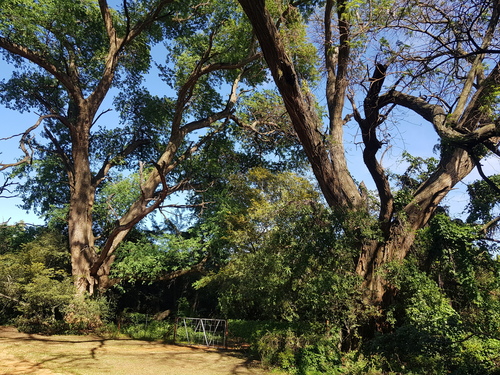
monkey thorn
Senegalia galpinii
A towering icon of the African bushveld, the Monkey thorn is easily identified by its claw-like thorns and massive, umbrella-shaped canopy. It is a biological hub, hosting everything from nesting raptors to nectar-hungry sunbirds.
Quick Identification
Size
Height: 25-30m (82-98ft); Canopy spread: 15-20m (49-65ft); Trunk diameter: up to 1.5m (5ft)
Colors
Pale grey to yellowish-brown corky bark; lime-green feathery foliage; creamy-white flower spikes; dark purple-brown seed pods
Key Features
- Large hooked thorns in pairs that resemble cat or monkey claws
- Deeply fissured, yellowish-corky bark on mature specimens
- Creamy-white to pale yellow cylindrical flower spikes appearing in early spring
- Large, flat, papery seed pods that turn a distinct purple-brown
When You’ll See Them
Geographic range
Where Does the monkey thorn Live?
The Monkey thorn is a quintessential species of the southern African interior, native to the subtropical and semi-arid regions of the continent. Its core range is centered in the northern provinces of South Africa, particularly Limpopo and North West, and it is a common sight throughout the bushveld of Botswana and Zimbabwe. While it is naturally found in the wild across Namibia and Mozambique, it has been widely introduced as an ornamental shade tree in urban parks and large gardens across the broader Southern African Development Community (SADC) region.
Basemap © OpenStreetMap contributors
Behavior
The Monkey thorn is a deciduous, fast-growing giant of the African savanna. It is an 'architectural' tree, developing a massive, spreading canopy that provides essential shade and micro-habitats for a vast array of wildlife. In early spring, often before the first leaves appear, the tree produces a spectacular display of creamy-white flower spikes that are rich in nectar, attracting swarms of bees, butterflies, and nectar-feeding birds.
As an ecological cornerstone, the tree's growth pattern is influenced by its environment; in open savannas, it spreads wide, while in riverine areas, it reaches significant heights to compete for light. It interacts with humans primarily as a popular choice for large-scale landscaping and shade in parks and sprawling suburban estates, though its aggressive root system and large thorns mean it requires significant space.
EverydayEarth exclusive
Camera Tips
When targeting a Monkey thorn with your AI camera, focus on the biodiversity 'hotspots' within the tree. During the spring flowering season (September to October), mount your camera on a sturdy branch facing the newly formed flower spikes. Sunbirds, bees, and butterflies are frequent visitors during this time, and the contrast of the creamy flowers against the blue sky provides excellent lighting for motion-trigger sensors.
To capture larger mammals, place your camera approximately 1 to 1.5 meters off the ground, facing the main trunk. The Monkey thorn’s name comes from monkeys using the hooked thorns to climb, but the tree is also a popular 'rubbing post' for rhinos, kudu, and even elephants in wilder areas. In a backyard setting, you are likely to capture squirrels or vervet monkeys navigating the trunk. Ensure the camera is angled slightly upward to catch the action as they ascend.
The large, purple-brown pods that drop in late summer and winter are a major food source. Positioning a camera at the base of the tree during these months is ideal for spotting ground-dwelling wildlife like francolins, guinea fowl, and various antelope species foraging for fallen seeds. Because the bark is very rough and corky, use a mount with a padded strap to prevent damage to the tree and to ensure the camera doesn't slip during heavy winds.
For those interested in the tree's development, use a time-lapse setting. The Monkey thorn grows rapidly, and documenting its transition from a bare winter skeleton to a lush, flowering canopy provides fascinating content. Set the camera to take one photo every day at noon to minimize shadow shifts and create a smooth seasonal transition video.
Similar Species
Species that look similar or are commonly confused with monkey thorn.
Frequently Asked Questions
Record monkey thorn at your habitat
Connect a camera to start building your own species record — AI identifies every visitor automatically.