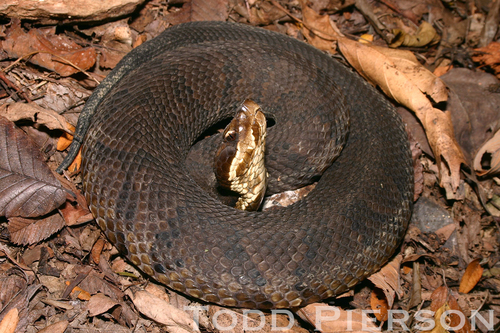
Northern Cottonmouth
Agkistrodon piscivorus
The Northern Cottonmouth is North America's only semiaquatic viper, a heavy-bodied master of the southern swamps. Famous for its white-mouthed threat display and its role as a top wetland predator, this snake is a fascinating subject for any backyard naturalist.
Quick Identification
Size
76–122 cm (30–48 inches) in length; heavy-bodied, weighing between 1.5–4.5 kg (3.3–10 lbs)
Colors
Dark olive, brown, or black with dark crossbands; belly is pale with dark blotches; juveniles have bright patterns and yellow tail tips
Key Features
- Wedge-shaped head with heat-sensing pits
- Dark 'mask' stripe running through the eye
- Thick, heavy-set body with keeled scales
- White, cotton-like interior of the mouth displayed when threatened
When You’ll See Them
Geographic range
Where Does the Northern Cottonmouth Live?
The Northern Cottonmouth is a quintessential resident of the North American Southeast. Its native range stretches from the Coastal Plain of southeastern Virginia, spanning down through the entirety of Florida and extending west across the Gulf States into eastern Texas and Oklahoma. In the Mississippi Valley, its presence can be traced as far north as southern Illinois and Missouri, where it thrives in humid, low-elevation environments near permanent water sources.
Basemap © OpenStreetMap contributors
Behavior
The Northern Cottonmouth is a misunderstood and often maligned semiaquatic pit viper. While they have a reputation for being aggressive, they are actually quite reclusive and typically prefer to stand their ground or flee rather than strike. Their famous 'gaping' behavior—where they coil up and open their mouths wide to reveal the white lining—is a final warning to predators or humans to keep their distance. If left undisturbed, they are fascinating to watch as they navigate their watery domains with a buoyant, head-high swimming style.
These snakes are solitary hunters and highly efficient predators. They are one of the few vipers that are semi-aquatic, spending equal time basking on logs or low-hanging branches and hunting in shallow water. During the heat of the summer, they shift from being active during the day to being primarily nocturnal, utilizing their heat-sensing pits to locate warm-blooded prey in total darkness. While they are venomous and capable of a dangerous bite, they generally only interact with humans when stepped on or intentionally provoked.
EverydayEarth exclusive
Camera Tips
To capture the Northern Cottonmouth on camera, focus your efforts on the 'transition zones' where water meets land. Look for fallen logs that receive direct sunlight for several hours a day; these are prime basking spots. Position your camera at a low angle, about 6 to 12 inches off the ground, to capture the snake's profile and its distinctive head shape. Because these snakes move slowly when basking but can strike quickly, a high-speed trigger and a fast shutter speed are essential for clear images.
Since Cottonmouths are frequently active at night during the summer, ensure your camera has a high-quality infrared flash that won't overexpose subjects at close range. Placing a camera near a known frog-breeding pool or a shallow stream crossing can yield excellent results, as these are high-traffic hunting grounds. Avoid using 'lures' or bait, as these snakes are wary and bait may attract larger predators that could damage your equipment or move the snake along too quickly.
Check your camera settings for a 'burst mode.' When a Cottonmouth gapes or moves into the water, you'll want multiple frames to catch the action. During the cooler months of spring and autumn, time your checks for mid-afternoon when the temperature is highest. Safety is paramount: always use a long mounting stick or reach-tool when adjusting cameras in swampy areas, and never place your hands into crevices or under logs where a snake might be resting.
Frequently Asked Questions
Record Northern Cottonmouth at your habitat
Connect a camera to start building your own species record — AI identifies every visitor automatically.