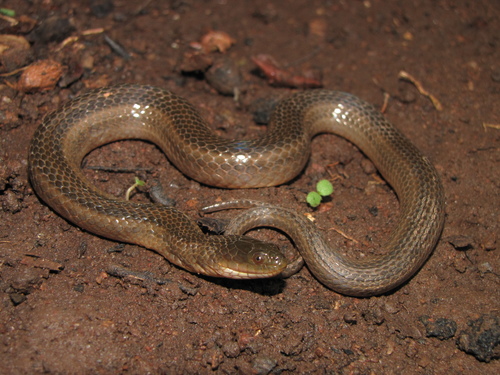
Olive Keelback
Helicops modestus
A hidden gem of the Brazilian wetlands, the Olive Keelback is a master of the underwater ambush. This non-venomous, semi-aquatic snake is a frequent visitor to suburban ponds and marshes across the Brazilian Highlands.
Quick Identification
Size
Typically 40–75 cm (16–30 inches) in total length, with females usually growing larger than males.
Colors
Dull olive-green, brownish, or dark gray upper body; belly is yellowish or cream, often featuring dark, checkered markings.
Key Features
- Strongly keeled (rough) scales along the back
- Small eyes positioned slightly toward the top of the head
- Uniform olive or brownish dorsal coloration
- Checkered or spotted pattern on the underside
When You’ll See Them
Geographic range
Where Does the Olive Keelback Live?
Native to South America, the Olive Keelback is an endemic resident of Brazil. It is most commonly found throughout the central and southeastern regions of the country, with established populations in the states of São Paulo, Rio de Janeiro, Minas Gerais, Mato Grosso do Sul, and Goiás. It is also a frequent inhabitant of the Federal District around Brasília, thriving in the wetlands of the Brazilian Highlands.
Basemap © OpenStreetMap contributors
Behavior
The Olive Keelback is a semi-aquatic specialist, spending a significant portion of its life in or near freshwater. It is a secretive species, typically remaining submerged or hidden among aquatic vegetation during the day to avoid predators. While it is primarily nocturnal, it can sometimes be spotted basking on muddy banks or low-hanging branches during quiet, sunny mornings.
In terms of temperament, the Olive Keelback is non-venomous and generally avoids human contact. When threatened, its first instinct is to dive into the water and disappear into the silt. If cornered, it may flatten its head and body to appear more intimidating or strike defensively, though it lacks the venom delivery system of its more dangerous distant relatives.
Socially, these snakes are solitary. One of their most interesting biological traits is that they are viviparous, meaning they give birth to fully formed live young rather than laying eggs. This allows the species to thrive in wet environments where eggs might otherwise rot or be lost to flooding.
EverydayEarth exclusive
Camera Tips
To capture the Olive Keelback on a wildlife camera, you must focus on the 'edge' habitats where water meets land. Look for flat, muddy banks or partially submerged logs near still water or slow-moving streams. These snakes often use the same exit and entry points in the mud; look for smooth 'slides' in the silt as an indicator of a high-traffic area. Mount your camera extremely low—no more than 10 centimeters off the ground—and angle it parallel to the shoreline for the best profile shots.
Since this species is primarily nocturnal and cold-blooded, traditional Passive Infrared (PIR) sensors may struggle to detect its heat signature against the cool nighttime mud. To overcome this, use a camera with a high-sensitivity sensor or set your device to a time-lapse mode during the peak activity hours of 6:00 PM to midnight. A 30-second interval can catch a snake gliding through the frame that a motion sensor might miss.
Lighting is critical for identifying the subtle olive tones of this species. If your camera has adjustable infrared settings, use a 'medium' or 'low' flash intensity to avoid washing out the reflective scales of the snake at close range. During the rainy season, when these snakes are most active, ensure your camera housing is well-sealed against humidity, as the damp environments they prefer can easily fog up a lens. Placing a small, flat rock just in front of the lens can provide a natural 'stage' for the snake to pause on, giving you a crystal-clear image.
Frequently Asked Questions
Record Olive Keelback at your habitat
Connect a camera to start building your own species record — AI identifies every visitor automatically.