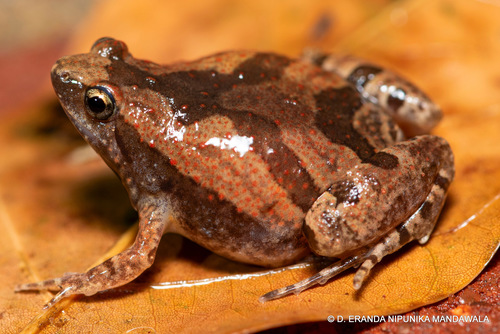
Ornate Narrow-mouthed Toad
Microhyla ornata
A miniature masterpiece of camouflage, the Ornate Narrow-mouthed Toad is the tiny architect of the monsoon's nightly chorus. Though small enough to hide under a single leaf, its striking patterns and resilient nature make it a fascinating find for any backyard explorer.
Quick Identification
Size
15–30 mm (0.6–1.2 inches) in length; small enough to fit on a human thumbnail.
Colors
Pale yellowish-brown to greyish-brown upper parts with a distinct dark brown symmetrical 'ornamented' pattern on the back; whitish or mottled throat in males.
Key Features
- Small pointed head with a narrow mouth
- Symmetrical dark brown leaf-like pattern on the back
- Toes with minimal webbing and small tips
- Characteristic high-pitched, rasping mating call
When You’ll See Them
Geographic range
Where Does the Ornate Narrow-mouthed Toad Live?
Native to the vibrant ecosystems of South Asia, the Ornate Narrow-mouthed Toad is widely distributed across the Indian subcontinent. Its core range includes India, Sri Lanka, Bangladesh, Nepal, and parts of Pakistan, extending even to the remote Andaman and Nicobar Islands. While it thrives in wilder forest edges, it has successfully colonized human-altered landscapes, making it one of the most common backyard amphibians in the region.
Basemap © OpenStreetMap contributors
Behavior
The Ornate Narrow-mouthed Toad is a secretive and primarily nocturnal amphibian. During the day, it remains expertly camouflaged under leaf litter, logs, or within loose soil to maintain moisture. Despite their diminutive size, they are incredibly agile; when disturbed, they utilize their powerful hind legs to execute rapid, erratic leaps that allow them to vanish into thick vegetation in seconds.
These toads are most famous for their explosive breeding behavior during the monsoon season. Following heavy rains, males emerge in massive numbers to congregate around temporary pools and puddles. They produce a loud, vibrating 'creee-creee' call that belies their tiny stature, often creating a deafening chorus that serves as a hallmark of rainy nights in South Asia. Outside of the breeding season, they lead solitary lives, rarely interacting with humans except when attracted to garden lights where insects congregate.
EverydayEarth exclusive
Camera Tips
Capturing the Ornate Narrow-mouthed Toad on camera requires a specialized approach due to their tiny size. Standard trail cameras mounted at waist height will miss them entirely. You must place your camera at 'ground level,' no more than 2 to 4 inches off the soil. Aim the lens toward the edges of garden ponds, damp flower beds, or areas where monsoon puddles naturally form, as these are the primary activity hubs for this species.
Lighting is your biggest challenge. Because these toads have moist, reflective skin, a standard white flash will often result in a 'blown-out' white blob in the photo. Use a camera with high-quality No-Glow infrared LEDs to minimize glare. If you are using a backyard AI camera, try placing it near an outdoor light source that attracts ants or termites; the toads will eventually find this 'buffet,' allowing you to capture natural foraging behavior without the harshness of a direct flash.
To maximize your chances, deploy your gear during the first heavy rains of the wet season. This is when they are most active and least cautious. If you want to create a permanent 'studio' for them, place a shallow terracotta saucer of water in a shady corner of your garden surrounded by some flat rocks or leaf litter. The toads will use this as a refuge, providing a predictable spot for your camera to trigger day after day.
Similar Species
Species that look similar or are commonly confused with Ornate Narrow-mouthed Toad.
Frequently Asked Questions
Record Ornate Narrow-mouthed Toad at your habitat
Connect a camera to start building your own species record — AI identifies every visitor automatically.