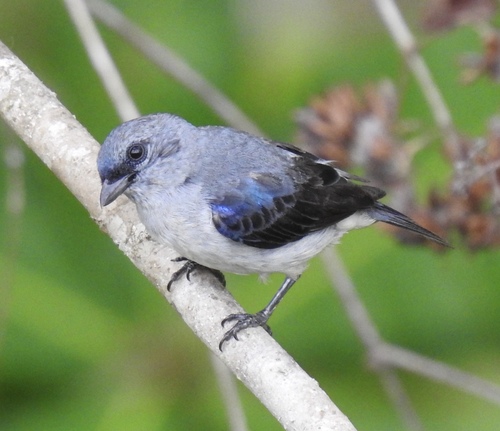
Plain-colored Tanager
Tangara inornata
The Plain-colored Tanager proves that you don't need bright colors to be captivating. A master of social foraging and subtle silvery tones, this energetic bird is a delightful frequent visitor to tropical gardens.
Quick Identification
Size
12–13 cm (4.7–5.1 in) in length; weighs approximately 15–20 g (0.5–0.7 oz)
Colors
Uniform ash-gray or silvery-gray plumage with subtle bright blue shoulder patches on the lesser coverts; sexes are identical.
Key Features
- Uniform silvery-gray plumage without streaks
- Small, stout black bill
- Bright blue shoulder patches often hidden while perched
- Restless, active foraging behavior
When You’ll See Them
Geographic range
Where Does the Plain-colored Tanager Live?
Central and South America are the native regions for this subtle beauty. Its core range spans from the Caribbean lowlands of Costa Rica through Panama and into the northern and western regions of Colombia. Unlike some deep-forest specialists, this species thrives in 'disturbed' habitats, making it a common sight in suburban areas and regenerating forests within its tropical range.
Basemap © OpenStreetMap contributors
Behavior
Their movement is characterized by quick, nervous hops and short flights between branches. Unlike some of their more territorial relatives, Plain-colored Tanagers are relatively peaceful and communal. They maintain social cohesion through a series of high-pitched, thin 'tsip' calls that help the flock stay together as they move rapidly through the tropical foliage.
EverydayEarth exclusive
Camera Tips
To successfully capture the Plain-colored Tanager on a backyard camera, focus your efforts on elevated platforms. These birds are canopy-dwellers by nature and feel most comfortable feeding at least 5 to 10 feet above the ground. Mounting your camera on a fence post or a tree trunk overlooking a high platform feeder is ideal. They are particularly fond of overripe bananas and plantains; securing these fruits to a branch or platform will keep the birds in the frame longer while they feed.
Lighting is the biggest challenge when photographing this species. Their plumage is a subtle, reflective silvery-gray that can easily look 'blown out' in harsh midday sun or appear muddy in deep shade. Position your camera to take advantage of the 'golden hour'—the first two hours after sunrise—when the soft light brings out the delicate texture of their feathers and the occasional flash of blue on their shoulders. Using a camera with a fast trigger speed is vital, as they are constantly on the move and rarely stay still for more than a few seconds.
If you live within their range, planting native fruiting shrubs like Miconia can create a natural 'studio' for your camera. Set your device to capture short video clips (10-15 seconds) rather than still photos. This allows you to see their social interactions with other birds and increases your chances of capturing the moment they flick their wings, revealing the hidden blue patches that are their most distinctive field mark. During the drier months, an elevated birdbath with a small dripper or fountain will be an irresistible draw for these active tanagers.
Similar Species
Species that look similar or are commonly confused with Plain-colored Tanager.
Blue-gray Tanager
Larger with a distinctly blue tint across the entire body and a larger, paler bill.
Palm Tanager
Larger and olive-drab or brownish-gray rather than silvery, with a distinct two-toned wing pattern.
Golden-hooded Tanager
While similar in size, it has a black body and vibrant gold and blue head markings, contrasting with the uniform gray of the Plain-colored.
Frequently Asked Questions
Record Plain-colored Tanager at your habitat
Connect a camera to start building your own species record — AI identifies every visitor automatically.