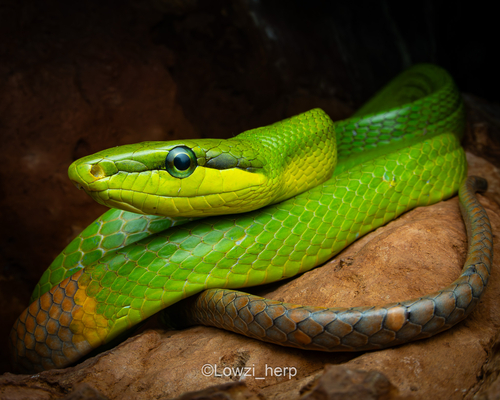
Red-tailed Green Ratsnake
Gonyosoma oxycephalum
A masterpiece of tropical evolution, the Red-tailed Green Ratsnake is a vivid emerald climber that brings a flash of color to the Southeast Asian canopy.
Quick Identification
Size
Adults typically reach 1.6 to 2.1 metres (5.2 to 6.9 feet), with exceptional specimens growing up to 2.4 metres (8 feet).
Colors
Bright lime-green to olive-green body; the tail is distinctly colored in shades of reddish-brown, grey, or dull orange; features a characteristic black horizontal line through the eye.
Key Features
- Vivid emerald green body scales with dark edges
- Distinctive reddish-brown or grey tail contrasting with green body
- Bright blue tongue frequently flicked when alert
- Large, alert eyes with a dark horizontal 'mask' streak
When You’ll See Them
Geographic range
Where Does the Red-tailed Green Ratsnake Live?
The Red-tailed Green Ratsnake is a quintessential resident of Southeast Asia, thriving across the tropical belt from the lush forests of Thailand, Myanmar, and Laos down through the Malay Peninsula. Its core range encompasses the vast archipelagos of Indonesia and the Philippines, where it is frequently spotted in both deep jungles and the outskirts of rural villages. While strictly native to these humid Asian regions, its striking appearance has made it a well-known species globally within the herpetological community.
Basemap © OpenStreetMap contributors
Behavior
The Red-tailed Green Ratsnake is a highly specialized arboreal hunter, spending the vast majority of its life in the canopy. Unlike many other ratsnakes that may forage on the forest floor, this species is designed for life in the trees, using its prehensile tail and strong, muscular body to navigate thin branches with ease. It is a diurnal species, meaning it is most active during the day, particularly during the morning hours when it basks to regulate its temperature before beginning its hunt.
In terms of temperament, these snakes are known for being high-strung and defensive. When threatened, they will often inflate their neck vertically to appear larger, exposing the dark skin between their scales, and may strike repeatedly if they cannot escape. Despite this bravado, they are non-venomous constrictors. In suburban environments, they are often tolerated or even welcomed by gardeners as they are incredibly efficient at controlling populations of tree-dwelling rodents and garden pests.
EverydayEarth exclusive
Camera Tips
To capture this arboreal acrobat, your camera placement needs to shift from the ground to the canopy. Aim for heights of 2 to 5 meters, focusing on horizontal branches that act as 'wildlife highways' between trees. These snakes are highly active hunters and will often use the same limb repeatedly if it provides a clear path to a bird's nest or a fruit-heavy tree that attracts rodents. If you have a garden with tall hedges or trellises, these are also prime locations for a well-placed camera.
Position your AI-powered camera to face away from direct sunlight to prevent the vivid green scales from overexposing in the tropical glare, which can make identification difficult. A fast shutter speed or high frame rate is essential; despite their size, Red-tailed Green Ratsnakes move with surprising speed when they detect movement or prey. Using a 'Burst Mode' or short video clips is often better than single photos to catch the snake's characteristic blue tongue in motion.
Since they are diurnal, ensure your camera is active throughout the daylight hours. While you shouldn't use food bait for snakes, you can attract them indirectly by maintaining a bird-friendly or rodent-friendly environment. A camera placed near a bird bath or a known nesting site in a tree is an excellent strategy, as these snakes are notorious nest raiders. During the rainy season, look for them on lower branches or even crossing fences, as they may move to find dryer spots or follow prey displaced by the weather.
Frequently Asked Questions
Record Red-tailed Green Ratsnake at your habitat
Connect a camera to start building your own species record — AI identifies every visitor automatically.