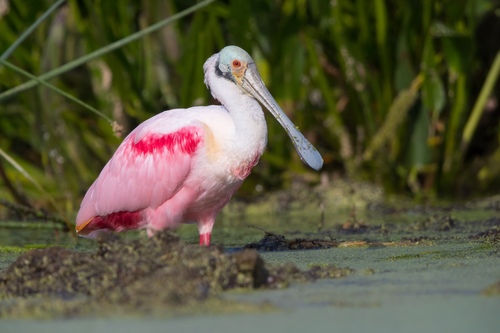
Roseate Spoonbill
Platalea ajaja
Often mistaken for flamingos at a distance, the Roseate Spoonbill is one of North America's most spectacular coastal residents. With its bright pink wings and unmistakable spoon-shaped bill, it brings a touch of the tropics to any backyard lagoon.
Quick Identification
Size
Length: 71-86 cm (28-34 in); Wingspan: 120-130 cm (47-51 in); Weight: 1.2-1.8 kg (2.6-4.0 lbs)
Colors
Pale pink body with vibrant carmine-pink wing coverts and tail; white neck and upper back; yellowish-green bald head; orange-buff tail feathers.
Key Features
- Flattened spatulate (spoon-shaped) bill
- Bright pink plumage with darker 'carmine' shoulder patches
- Pale green or gray bald head in adults
- Long, thin reddish-pink legs
When You’ll See Them
Sightings on EverydayEarth
Jul 21, 2026
Several wading birds are roosting in a tree over the swamp at night. A Black-crowned Night Heron perches prominently in the upper center of the frame, while a Roseate Spoonbill and other herons are nestled deeper within the foliage below. The birds are mostly stationary, occasionally shifting their heads or adjusting their positions on the branches.
Jul 21, 2026
At least two Roseate Spoonbills are roosting in the branches of a tree during the night. One bird in the upper-center of the frame remains tucked and still, while a second bird lower down is seen shifting its position and turning its head among the foliage.
Jul 20, 2026
Several wading birds are perched throughout the dense green canopy of a swamp. In the foreground, a Great Egret is seen preening its feathers, while a Roseate Spoonbill rests on a branch further back, its pink wings providing a splash of color against the foliage. Other white birds move and adjust their positions in the background as evening approaches.
Jul 18, 2026
A Roseate Spoonbill perches in a tree during the night, meticulously preening its feathers. The bird uses its distinctive spatulate bill to reach various parts of its body, showing typical nocturnal maintenance behavior.
Jul 18, 2026
Three Roseate Spoonbills are perched high in the branches of a tree at night. The birds are mostly stationary in a roosting posture, though the central individual is seen turning its head and adjusting its position, briefly revealing its distinctively shaped bill.
Jul 18, 2026
Several Roseate Spoonbills are perched high in a cypress tree at night. The birds are mostly stationary, likely roosting, though one occasionally shifts its head, revealing its unique spatula-like bill in the infrared light.
Behavior
Roseate Spoonbills are highly social wading birds that are almost always found in the company of other long-legged water birds like herons, egrets, and ibises. They are famous for their unique foraging behavior, which involves wading through shallow water while swinging their heads from side to side. They use their specialized bills to feel for prey, snapping them shut with a tactile reflex when they encounter a small fish or crustacean.
While they are relatively shy around humans, they have become increasingly common in suburban environments that feature retention ponds or backyard lagoons, particularly in coastal regions. They spend a significant portion of their day preening their vibrant feathers and resting in low-hanging trees or mangroves near the water's edge. At night, they congregate in large communal roosts to protect themselves from predators.
EverydayEarth exclusive
Camera Tips
To capture the best footage of a Roseate Spoonbill, camera placement is everything. These birds forage in very shallow water, usually less than six inches deep. Position your camera on a low-profile stake or tripod at the water's edge, aiming for a 'frog's eye view.' This low angle not only makes the bird look more majestic but also allows the camera to capture the intricate details of their spoon-shaped bill as it breaks the surface of the water.
Lighting is the most critical factor for showcasing their iconic pink color. For the best results, set your camera to face away from the sun during the 'golden hours' of early morning or late afternoon. Direct sunlight from behind the camera will make their carotenoid-rich feathers glow with an almost neon intensity. If your camera allows for manual exposure settings, slight underexposure can help prevent the bright white and pink areas of their plumage from appearing 'blown out' or losing detail in bright sun.
Because Roseate Spoonbills use a rhythmic, side-to-side sweeping motion to feed, they can sometimes trigger motion sensors frequently but result in blurred images if the shutter speed is too slow. Use a high-speed capture mode or 'Sports' setting if your camera supports it. If you are using an AI-powered camera, ensure the bird-detection sensitivity is set to high, as their unique shape can sometimes be misidentified by sensors optimized for more common songbirds.
While you cannot attract spoonbills with traditional feeders, you can entice them by maintaining a healthy, chemical-free aquatic environment if you have a backyard pond. They are attracted to movement and the presence of other wading birds. Decoys of herons or other spoonbills can sometimes encourage a passing flock to land in your area. Avoid clearing all the 'muck' or vegetation from your pond's edge, as this habitat supports the small crustaceans that spoonbills rely on for food.
Similar Species
Species that look similar or are commonly confused with Roseate Spoonbill.
American Flamingo
Much taller with a longer neck and a thick, bent bill rather than a flat, spoon-shaped one.
Wood Stork
Similar in shape and size but has mostly white plumage with black wingtips and a dark, scaly-looking head.
Great Egret
Similar size and habitat, but entirely white with a sharp, pointed yellow bill.
Frequently Asked Questions
Record Roseate Spoonbill at your habitat
Connect a camera to start building your own species record — AI identifies every visitor automatically.