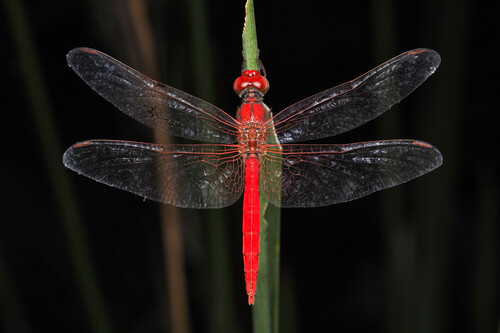
Scarlet Percher
Diplacodes haematodes
The Scarlet Percher is one of the most striking dragonflies in the Southern Hemisphere, characterized by the male's intense, fiery red body. A master of the 'sit and wait' hunting style, it is a common and welcome visitor to sunny backyard ponds.
Quick Identification
Size
Length: 30-35 mm (1.2-1.4 in); Wingspan: 50-60 mm (2.0-2.4 in)
Colors
Males are a brilliant, uniform scarlet red; females are yellow-ochre with distinctive yellow tinting on the outer wing edges.
Key Features
- Small, robust dragonfly build
- Males are entirely brilliant red including the face and eyes
- Preference for perching on hot rocks or ground rather than plants
- Females have yellow shading on the outer half of wings
When You’ll See Them
Geographic range
Where Does the Scarlet Percher Live?
The Scarlet Percher is a spectacular resident of the Australasian region, with its core population centered across the Australian continent. It is found in nearly every Australian state, thriving in both the tropical north and the more temperate south. Beyond Australia, its range extends across the Arafura Sea into Papua New Guinea and Timor-Leste, and it is a common sight across the Pacific islands of New Caledonia and Vanuatu. It is a highly adaptable species that successfully colonizes both remote wilderness waterways and suburban backyard ponds.
Basemap © OpenStreetMap contributors
Behavior
The Scarlet Percher is a territorial and highly active dragonfly known for its distinct basking habits. Unlike many other dragonfly species that prefer to rest on swaying reeds or thin twigs, the Scarlet Percher lived up to its name by seeking out solid, sun-warmed surfaces. You will frequently spot them on hot rocks, concrete paths, or even bare patches of red earth near water sources. This behavior helps them maintain a high body temperature, which is crucial for their lightning-fast aerial maneuvers.
These dragonflies are famously wary and possess incredible eyesight. They are often the first to fly away when approached, making them a challenge for casual observers. Once they take flight, they often hover briefly before returning to the exact same 'perch' they just left. This site fidelity makes them excellent subjects for patient wildlife photographers who can anticipate their return to a favorite sun-soaked stone.
EverydayEarth exclusive
Camera Tips
To successfully capture a Scarlet Percher on camera, you must understand their preference for thermal basking. Instead of pointing your camera at tall grass or reeds, focus your lens on flat, sun-drenched surfaces like large river stones, wooden decking, or light-colored pavement near a water source. These insects are attracted to heat, so the warmest spot in your garden is the most likely place for a male to establish his territory.
Place your camera at a very low angle, roughly 10 to 20 centimeters off the ground, and use a tripod to keep the frame steady. Because these dragonflies are extremely sensitive to movement, a remote trigger or a motion-activated AI camera is highly recommended. Set your shutter speed to at least 1/1000th of a second if you hope to catch them in flight, as their wingbeats are incredibly fast. If using a trail camera, ensure the 'trigger speed' is set to its fastest possible setting.
The best time to record activity is during the peak heat of the day, typically between 11:00 AM and 2:00 PM, when their red coloration appears most saturated under direct sunlight. You can encourage them to visit a specific 'photo zone' by placing a flat, dark rock in a sunny spot near a pond. Ensure the area is free of tall shadows, as the sudden movement of a shadow will cause the Percher to flee immediately. For the best results, use a macro setting or a long telephoto lens to maintain a respectful distance that doesn't trigger their flight response.
Similar Species
Species that look similar or are commonly confused with Scarlet Percher.
Frequently Asked Questions
Record Scarlet Percher at your habitat
Connect a camera to start building your own species record — AI identifies every visitor automatically.