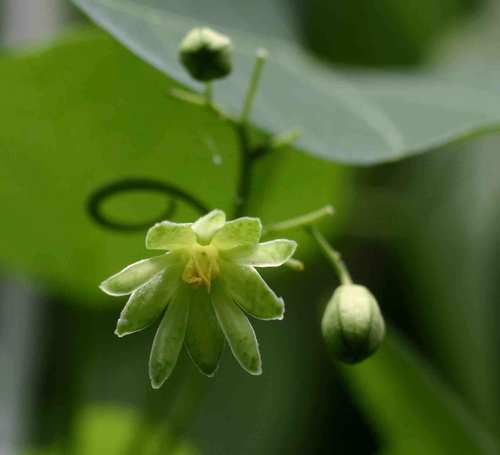
snake-climber
Adenia gummifera
The snake-climber is a fascinating woody liana that mimics the form of a serpent as it winds through the African canopy. A vital host for butterflies, it brings vertical complexity and a touch of the wild to any backyard forest garden.
Quick Identification
Size
Stems reach up to 30 m (100 ft) in length; base diameter 10-15 cm (4-6 in).
Colors
Pale green to glaucous grey stems, bright green foliage, and small greenish-yellow flowers.
Key Features
- Thick, succulent-like woody stems resembling snakes
- Climbs via specialized axillary tendrils
- Leaves are deeply 3-lobed and heart-shaped at the base
- Produces green capsules that ripen to a bright, toxic orange.
When You’ll See Them
Geographic range
Where Does the snake-climber Live?
Native to the African continent, the snake-climber thrives across a wide longitudinal band of eastern and southern regions. Its core range extends from the lush corridors of Ethiopia and Somalia down through Kenya, Tanzania, and Mozambique, reaching its southern limits in the wooded grasslands and coastal forests of South Africa. It is a resilient species often found bridging the gap between dense forest interiors and more open suburban garden edges.
Basemap © OpenStreetMap contributors
Behavior
The snake-climber is a vigorous perennial liana known for its uncanny resemblance to a serpent winding through the canopy. While it is a plant, its presence in the backyard is dynamic; it is a master of structural opportunistic growth, using specialized tendrils to latch onto neighboring trees and shrubs. It often forms dense, tangled curtains of vegetation in the mid-canopy that provide essential cover and nesting sites for small birds and reptiles.
In backyard ecosystems, this species acts as a vital nursery and food source for specific wildlife. It is the primary host plant for several species of Acraea butterflies, whose larvae feed on the foliage. Despite its attractive appearance, the plant contains cyanogenic glycosides, making it highly toxic to most mammals. This chemical defense ensures that while it supports specialized insects, it remains largely untouched by larger herbivores.
EverydayEarth exclusive
Camera Tips
Capturing the snake-climber on an AI-powered camera requires a shift in perspective, as you are monitoring a stationary but evolving biological structure. To document its unique 'snaky' growth, mount your camera at chest height (4-5 feet) on a neighboring tree, angled toward the thickest part of the vine’s woody base. This allows the AI to trigger on the subtle movements of the foliage or the arrival of its many specialized pollinators. Use a wide-angle lens setting if available to capture the full scale of the climbing habit as it interacts with the host tree.
Since the snake-climber is a magnet for Acraea butterflies, position your camera near the fresh leaf growth during the spring and summer months. Set your trigger sensitivity to 'High' to capture the fast-moving butterflies and the slow progression of their brightly colored caterpillars. For the best visual results, ensure the camera is positioned to avoid direct midday sun, which can wash out the subtle grey-green texture of the stems; early morning or late afternoon light provides the best contrast for identifying the distinct leaf shapes.
If you are interested in the plant’s seasonal changes, utilize a time-lapse mode. Set the camera to take one photo every 6-12 hours over several months. This will dramatically showcase the 'snake' as it winds its way up its support structure and produces its striking orange fruits. Be aware that the fruits are toxic; if your camera captures local wildlife investigating them, you may observe the cautious behavior of animals that have learned to avoid this potent plant, providing fascinating data on local animal intelligence and foraging habits.
Similar Species
Species that look similar or are commonly confused with snake-climber.
Frequently Asked Questions
Record snake-climber at your habitat
Connect a camera to start building your own species record — AI identifies every visitor automatically.