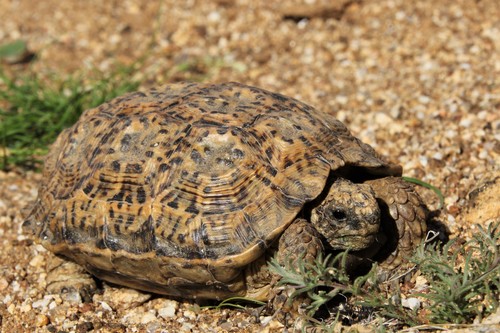
Speckled Tortoise
Chersobius signatus
Meet the world's smallest tortoise, a tiny treasure of the South African desert that fits in the palm of your hand. Endemic to the rocky Namaqualand landscape, these speckled wonders are masters of hiding in plain sight.
Quick Identification
Size
Length: 6–10 cm (2.4–4 in); Weight: 95–165 g (3.4–5.8 oz)
Colors
Orange-brown or tan shell with hundreds of tiny black speckles; males are smaller and more brightly colored than females
Key Features
- World's smallest tortoise species
- Flattened carapace (shell) designed for squeezing into rock cracks
- Five toes on the front feet
- Distinctive dense pattern of black specks on a lighter background
When You’ll See Them
Geographic range
Where Does the Speckled Tortoise Live?
Native exclusively to the African continent, the Speckled Tortoise is a narrow-range endemic found only in the Little Namaqualand region of western South Africa. Its core range is extremely limited, centered within the rocky hills of the Northern Cape province, and it is not found naturally in any other part of the world. This specialist species is strictly tied to the unique geography of the Succulent Karoo, making it one of the most geographically restricted tortoises on Earth.
Basemap © OpenStreetMap contributors
Behavior
The Speckled Tortoise is a remarkably shy and secretive creature, spending a significant portion of its life tucked away in the narrow fissures of granite boulders. Unlike larger tortoises that rely solely on their heavy shells for protection, this species uses its tiny size and flattened profile to wedge itself into unreachable gaps in the rock. They are most active during the early morning and late afternoon when temperatures are moderate, emerging to forage on the succulent vegetation that grows in their arid environment.
Socially, they are mostly solitary, though multiple individuals may share high-quality rock crevices during periods of extreme weather. During the breeding season, males become more active and can be seen navigating the rocky terrain in search of females. While they are generally wary of humans, they are highly sensitive to habitat disturbance. In their native South African range, they are rarely seen by the casual observer due to their exceptional camouflage and preference for staying close to their rocky retreats.
EverydayEarth exclusive
Camera Tips
Capturing the world's smallest tortoise on camera requires a micro-level approach to placement. Since these tortoises rarely exceed four inches in length, your camera must be positioned extremely low—ideally no more than 2 to 3 inches off the ground. Aim your lens at 'crevice corridors'—the flat areas of soil or rock immediately adjacent to deep fissures in granite boulders where the tortoises hide. Using a camera with a short focal distance or macro capabilities is essential, as standard trail cameras may produce blurry images if the tiny tortoise passes too close to the lens.
Time your deployment for the Southern Hemisphere spring (late winter to early spring), specifically between July and October. This is when the Namaqualand desert blooms and the tortoises are most active, foraging for flowers and searching for mates. Focus your efforts on the sunnier North and East-facing slopes of rocky 'koppies,' as these areas warm up first in the morning, prompting the tortoises to emerge from their rocky retreats to bask and feed.
Because they are herbivores, traditional meat-based baits won't work. Instead, look for their favorite natural food sources—brightly colored succulents or tiny yellow flowers—and set your camera to monitor those specific patches. Avoid moving the rocks or disturbing the environment, as this can scare them into hiding for days. Set your camera to 'Burst Mode' or high-frame-rate video; because they are so small and vulnerable, they can move through the frame surprisingly quickly when traveling between hiding spots.
Frequently Asked Questions
Record Speckled Tortoise at your habitat
Connect a camera to start building your own species record — AI identifies every visitor automatically.