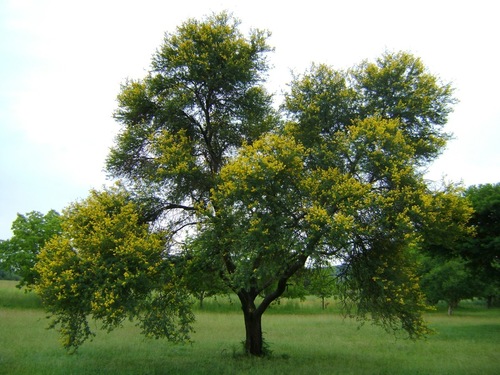
Sweet Thorn
Vachellia karroo
A resilient icon of the African landscape, the Sweet Thorn is more than just a tree—it's a high-security wildlife sanctuary known for its golden 'puffball' flowers and protective white spines.
Quick Identification
Size
Typically 4–15 m (13–49 ft) in height, though can reach 22 m (72 ft) in ideal conditions; crown spread varies widely.
Colors
Dark reddish-brown to black bark; bright yellow pom-pom flowers; vivid green foliage; stark white thorns.
Key Features
- Bright yellow globose 'puffball' flowers
- Pairs of long, straight white thorns up to 25cm long
- Reddish-brown bark that becomes rough and fissured with age
- Fine, feathery bipinnate leaves
When You’ll See Them
Geographic range
Where Does the Sweet Thorn Live?
Native to the southern tip of the African continent, the Sweet Thorn is one of the most widely distributed trees in the region. Its core range spans across South Africa, Namibia, Botswana, and Zimbabwe, stretching eastward into Mozambique and northward into southern Angola. While it is a signature species of the South African interior, it has also been introduced to parts of Australia and the Mediterranean, where it is valued for its hardiness.
Basemap © OpenStreetMap contributors
Behavior
The Sweet Thorn is a cornerstone of the southern African ecosystem, acting as a 'pioneer species' that thrives in disturbed soils and improves them through nitrogen fixation. While it doesn't move like an animal, it exhibits fascinating seasonal 'behaviors,' such as producing a sweet-tasting, edible golden gum from wounds in its bark. This gum is a vital food source for various wildlife, particularly during the dry winter months.
In a backyard or wild setting, the Sweet Thorn is a social hub. Its dense, thorny canopy provides a 'fortress' for nesting birds, protecting them from larger predators. Humans have historically used the tree for everything from medicinal bark infusions to fence posts, and it remains a favorite for gardeners looking to attract pollinators, as the fragrant summer blooms draw in a massive variety of bees, butterflies, and beetles.
EverydayEarth exclusive
Camera Tips
When using an AI-powered camera with a Sweet Thorn, don't just aim at the tree—aim at the activity hubs. To capture elusive nocturnal visitors like the Lesser Bushbaby (Galago), position your camera 1.5 to 2 meters off the ground, facing a section of the trunk where the golden gum is oozing. These primates are highly attracted to the sweet sap and will return to the same 'bleeding' spot night after night. Use a fast shutter speed or a short video burst to catch their quick, jerky movements.
For bird enthusiasts, the mid-canopy is where the action happens. Look for the fork of a branch where the white thorns are most dense; this is a prime nesting site for weavers and sunbirds. Angle your camera slightly downward from an adjacent structure or higher branch to get a clear view into the canopy without the thorns obscuring the lens. If your camera has a macro or close-up setting, the bright yellow flowers in summer are a magnet for iridescent beetles and butterflies, providing vibrant, colorful triggers during the day.
Consider the lighting: the Sweet Thorn's white spines can cause 'flare' or overexposure in direct sunlight or with a strong flash. To avoid this, position your camera facing South (in the Southern Hemisphere) to ensure even, indirect lighting on the bark and thorns. In winter, when the leaves thin out, the tree provides an excellent skeletal frame for capturing raptors like the Spotted Eagle-Owl that often use the high, sturdy branches as a lookout point for hunting rodents below.
Similar Species
Species that look similar or are commonly confused with Sweet Thorn.
Frequently Asked Questions
Record Sweet Thorn at your habitat
Connect a camera to start building your own species record — AI identifies every visitor automatically.