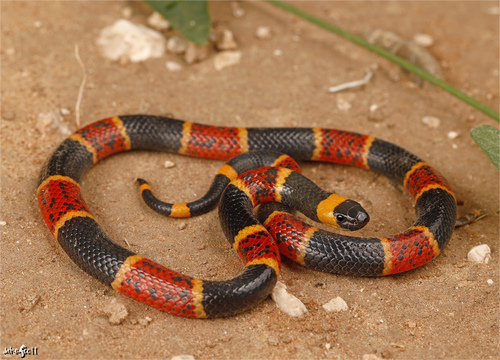
Texas Coralsnake
Micrurus tener
The Texas Coralsnake is a vibrant, reclusive jewel of the southern landscape. Recognizable by its iconic red, yellow, and black bands, this shy burrower offers a rare and beautiful glimpse into the complexity of backyard biodiversity.
Quick Identification
Size
20–30 inches (51–76 cm) on average; record length up to 48 inches (122 cm)
Colors
Banded with broad red and black rings separated by thin yellow rings; black snout
Key Features
- Red and yellow rings touch each other
- Entirely black snout
- Slender, cylindrical body with smooth scales
When You’ll See Them
Geographic range
Where Does the Texas Coralsnake Live?
Native to the North American continent, the Texas Coralsnake is a signature resident of the southern and southwestern United States and northeastern Mexico. Its core range spans across nearly all of Texas, reaching into western Louisiana and southwestern Arkansas. South of the border, it thrives across the Mexican states of Coahuila, Nuevo León, and Tamaulipas, inhabiting a variety of terrains from coastal plains to inland plateau edges.
Basemap © OpenStreetMap contributors
Behavior
The Texas Coralsnake is a notoriously shy and reclusive species that spends the vast majority of its life hidden from view. Unlike many other venomous snakes that may coil and strike when threatened, this species prefers to flee or hide its head within its coils, often waving its upturned tail to distract predators. They are fossorial by nature, meaning they are well-adapted for burrowing and are frequently found under leaf litter, rotting logs, or underground in abandoned burrows.
While they possess a potent neurotoxic venom, they are not aggressive toward humans and bites are extremely rare, usually occurring only when a snake is accidentally stepped on or intentionally handled. In the backyard setting, they are solitary hunters that move with a slow, deliberate grace. Their presence is often a sign of a healthy ecosystem with plenty of cover and a robust population of smaller reptiles.
EverydayEarth exclusive
Camera Tips
Capturing a Texas Coralsnake on camera requires a strategy focused on micro-habitats. Because these snakes are small and ground-dwelling, place your camera as low to the ground as possible—ideally just 2-3 inches above the surface. Aim the lens at 'natural highways' such as the edge of a garden stone wall, a large fallen log, or the transition zone between a manicured lawn and thick brush. Since they are slender, a camera with a high-sensitivity PIR sensor is essential to trigger the shutter.
Standard trail camera focal lengths can sometimes result in blurry images for such close-up subjects. If your camera allows, use a macro lens attachment or a model with a short minimum focus distance. Position the camera near piles of damp leaf litter or pine straw, especially after a light rain, as these conditions often draw the snakes out of their subterranean retreats to hunt. Setting your camera to 'Burst Mode' or 'Photo + Video' is highly recommended to capture their fluid movement across the frame.
Timing is everything with this species. They are most active during the moderate temperatures of spring and autumn. During the heat of a Texas summer, they become almost exclusively crepuscular or nocturnal, so ensure your camera has high-quality IR LEDs for clear black-and-white nighttime footage. Avoid using bright white-flash cameras, as the sudden light can startle the animal and cause it to flee before you get a second shot. No artificial bait is necessary; simply providing a 'messy' corner of the yard with natural cover is the best way to encourage a visit.
Similar Species
Species that look similar or are commonly confused with Texas Coralsnake.
Frequently Asked Questions
Record Texas Coralsnake at your habitat
Connect a camera to start building your own species record — AI identifies every visitor automatically.