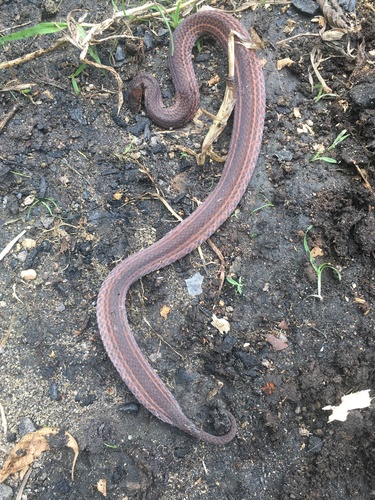
Western Ground Snake
Atractus occidentalis
A secretive inhabitant of the Ecuadorian forest floor, the Western Ground Snake is a master of the subterranean world. This harmless, iridescent reptile is a vital part of the ecosystem, spending its nights hunting for invertebrates beneath the leaf litter.
Quick Identification
Size
25-45 cm (10-18 inches) in length; slender, cylindrical body roughly the diameter of a pencil.
Colors
Typically dark chocolate brown or reddish-brown dorsally; sometimes features faint dark longitudinal lines; belly is creamy white or pale yellow.
Key Features
- Small blunt head not distinct from the neck
- Smooth, highly iridescent scales
- Small eyes with round pupils
- Fossorial, cylindrical body shape built for burrowing
When You’ll See Them
Geographic range
Where Does the Western Ground Snake Live?
The Western Ground Snake is native to the South American continent, where it is found exclusively in Ecuador. Its core range is situated along the western slopes of the Andes mountains, occupying the humid subtropical and tropical zones. It is a regional endemic, meaning it is found nowhere else in the wild, thriving in areas where the soil remains consistently damp and rich in organic matter.
Basemap © OpenStreetMap contributors
Behavior
The Western Ground Snake is a highly secretive, fossorial reptile that spends the vast majority of its life underground or hidden beneath deep layers of leaf litter. Unlike more active hunters that roam the surface, these snakes are slow-moving and rely on their ability to navigate the loose soil and organic debris of the forest floor. They are entirely harmless to humans, lacking any venom or aggressive tendencies; when uncovered, their primary defense is to quickly 'swim' back into the dirt or coil into a tight ball.
Because they are so reclusive, they are rarely seen by casual observers. They are most active during periods of high humidity or immediately following heavy rainfall, which brings their prey to the surface and makes the soil easier to burrow through. They are generally solitary creatures, though multiple individuals may occasionally be found in the same prime microhabitat, such as under a particularly large, moisture-retaining log.
EverydayEarth exclusive
Camera Tips
Capturing the Western Ground Snake on camera requires a specialized approach because of their fossorial nature. Since these snakes rarely climb or travel across open ground, place your camera at ground level, ideally near rotting logs, large flat stones, or thick piles of damp leaf litter. Using a macro lens or a camera with a very short focal distance is essential, as these snakes are small and their distinctive scale patterns won't be visible from a standard trail camera distance.
Because they are most active when the ground is saturated, the best time to set up your gear is immediately following a heavy tropical downpour. Focus your lens on 'natural highways' like the edge of a garden path, the base of a retaining wall, or a clear patch of mud between two areas of thick vegetation. Since they are strictly nocturnal, ensure your camera has a high-quality infrared flash that won't overexpose shiny, reflective surfaces at close range.
For those looking to encourage a sighting in a backyard or study area, maintaining a healthy 'mulch zone' is key. Avoid chemical pesticides that kill off earthworms, their primary food source. A damp, shaded corner with plenty of organic debris, such as fallen leaves and decaying wood, will act as a natural lure. Set your camera to take rapid-fire bursts or short video clips, as their movements can be surprisingly fluid and quick once they decide to re-bury themselves.
Frequently Asked Questions
Record Western Ground Snake at your habitat
Connect a camera to start building your own species record — AI identifies every visitor automatically.