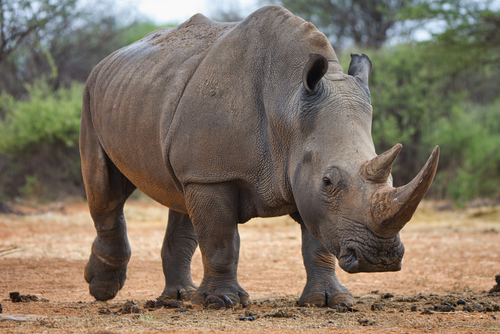
White Rhinoceros
Ceratotherium simum
The White Rhinoceros is a magnificent relic of a bygone era, wandering the African plains as the world’s largest grazer. Known for its social nature and distinctive square lip, this gentle giant is a masterpiece of savanna evolution.
Quick Identification
Size
Length: 3.4–4.2 m (11–13.8 ft); Height: 1.6–1.86 m (5.2–6.1 ft); Weight: 1,700–2,400 kg (3,700–5,300 lbs)
Colors
Slate gray to yellowish-brown skin; no distinct color markings between sexes, though males are generally larger and have thicker horns.
Key Features
- Wide, square-shaped upper lip for grazing
- Two keratin horns on the snout, with the front horn being significantly longer
- Large muscular hump on the back of the neck
- Fringed ears and a barrel-shaped body with very little hair
When You’ll See Them
Sightings on EverydayEarth
Aug 2, 2026
Two White Rhinoceroses, likely a mother and her calf, are standing in the center of the dusty enclosure, occasionally lowering their heads to explore the ground. In the background near the fence line, a group of warthogs is busy foraging in the dirt, kneeling on their front legs to reach the sparse vegetation and roots.
Aug 1, 2026
Three white rhinoceros are seen resting in the enclosure at night. One rhino is positioned very close to the camera in the foreground, with its ears occasionally twitching. Two others, an adult and a smaller calf, are lying down together in the background near a wooden fence.
Aug 1, 2026
A group of white rhinoceroses, known as a crash, is resting together in a sandy clearing during the night. Most are lying down or sleeping under the branches of a tree near a wooden fence. In the lower-left foreground, a scrub hare is briefly visible, its eyes reflecting the camera's infrared light as it sits near the resting giants.
Jul 31, 2026
A group of white rhinoceroses are gathered under a tree, resting and sleeping through the night. Most remain still, while one or two occasionally shift their heads or twitch their ears in the quiet nighttime environment.
Jul 31, 2026
A group of White Rhinoceroses are huddled together and resting on the ground during the night. A lone domestic sheep walks calmly past the resting giants, moving from the left side of the frame towards the background.
Jul 30, 2026
A group of white rhinoceroses are resting together in a sandy enclosure at night. Most of the animals are lying down and appear to be sleeping, while one in the center occasionally shifts its head slightly.
Behavior
Unlike their more solitary cousins, the White Rhinoceros is the most social rhino species. They are often found in small groups known as 'crashes,' which typically consist of a mother and her calves or several sub-adults. Dominant males are the exception, usually remaining solitary as they patrol and defend territories that overlap with several female ranges.
Communication is vital to their social structure, involving a variety of vocalizations like grunts, snorts, and bellows. However, their most famous method of 'social media' is the use of communal dung heaps called middens. These sites act as communication hubs where individuals leave scent markers to convey information about their health, age, and reproductive status to others in the area.
EverydayEarth exclusive
Camera Tips
When setting up cameras for White Rhinoceros, durability and placement are your two biggest concerns. Because these giants weigh over two tons and have a habit of using sturdy objects as scratching posts, standard plastic mounts will not suffice. We recommend using heavy-duty steel security boxes (bear boxes) lagged directly into a thick, hardwood tree or a reinforced metal post. Position the camera at chest height—roughly 3 to 4 feet off the ground—and angle it slightly downward to capture the distinctive square lip and horn structure.
The most reliable locations for consistent captures are communal dung middens and well-used water holes. Rhinos are creatures of habit and will return to these specific 'scent stations' daily to communicate with the rest of the crash. If you are placing a camera near a water source, target the muddiest sections; White Rhinos love to wallow to regulate their temperature and protect their skin from parasites. A wide-angle lens is preferable here, as these animals are massive and can easily fill the entire frame if they pass too close.
For camera settings, use a high trigger speed. While they often move at a slow, prehistoric plod, they can accelerate to 40 mph in an instant if spooked. Set your camera to take 'burst' photos or 15-20 second videos to capture their social interactions. Since they are most active during the cooler twilight hours, ensure your camera has high-quality Infrared (IR) LEDs for clear night vision without a visible flash that might startle them. In the dry season, the dust can be thick, so regularly cleaning the lens and PIR sensor is essential for clear imagery.
Similar Species
Species that look similar or are commonly confused with White Rhinoceros.
Frequently Asked Questions
Record White Rhinoceros at your habitat
Connect a camera to start building your own species record — AI identifies every visitor automatically.