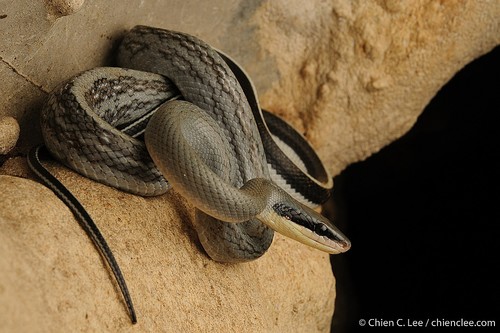
Beauty Ratsnake
Elaphe taeniura
A masterpiece of evolution, the Beauty Ratsnake combines striking 'beauty' markings with unparalleled climbing agility. This long, slender hunter is a gardener's best friend, providing expert natural pest control across the forests and suburbs of Asia.
Quick Identification
Size
1.2 to 2.4 meters (4 to 8 feet) in length; rarely exceeding 3 meters (10 feet). Slender build.
Colors
Yellowish-brown to olive-drab base; prominent black stripe running from the eye to the corner of the mouth; ladder-like pattern on the back that transitions into four dark stripes on the tail.
Key Features
- Distinctive black 'beauty' mask through the eyes
- Long, slender body with a highly prehensile tail
- Dorsal pattern of twin stripes that fade into a checkered or ladder pattern
- Cream or pale yellow underbelly with dark speckling.
When You’ll See Them
Geographic range
Where Does the Beauty Ratsnake Live?
The Beauty Ratsnake is native to the vast landscapes of East and Southeast Asia, stretching from the subtropical forests of southern China and Taiwan down through the Indochinese Peninsula. It maintains strong populations across Vietnam, Thailand, Myanmar, and Malaysia, thriving in both lowland jungles and montane forests. Beyond its native range, it has been introduced to the Okinawa Islands in Japan, where it has successfully established itself as an invasive species.
Basemap © OpenStreetMap contributors
Behavior
The Beauty Ratsnake is a highly active and intelligent serpent known for its impressive climbing abilities. As a semi-arboreal species, it is just as comfortable gliding through the forest canopy as it is navigating the rocky crevices of a cave or the rafters of a suburban shed. They are primarily diurnal, meaning they are active during the day, though they may shift to crepuscular activity during the hottest summer months to avoid the midday sun.
When it comes to human interaction, these snakes are generally shy and will attempt to flee at the first sign of trouble. However, if cornered, they are known to be quite 'spunky' and defensive, often vibrating their tails against dry leaves to mimic a rattlesnake or striking repeatedly to deter a perceived predator. Despite this bravado, they are non-venomous constrictors and are often welcomed by farmers for their incredible efficiency at keeping rodent populations in check.
EverydayEarth exclusive
Camera Tips
To capture high-quality footage of a Beauty Ratsnake, you need to think vertically. Because these snakes are semi-arboreal, placing your camera at ground level might only catch a glimpse of their tail as they move upward. Instead, try mounting your camera 3 to 5 feet off the ground, angled toward stone walls, large tree trunks, or the eaves of outbuildings where they often hunt for rodents and birds.
Since these snakes are attracted to high-traffic rodent areas, placing your camera near woodpiles or garden sheds is a winning strategy. You don't need specialized bait for the snake itself; rather, focus on areas where their prey is active. Use a high-sensitivity PIR (passive infrared) setting on your camera, as snakes are ectothermic and may not always trigger a sensor designed for warm-blooded mammals unless they have recently been basking in the sun.
Time-lapse mode can be a secret weapon for snake enthusiasts. Setting your camera to take a photo every 30 seconds during the peak morning hours (7 AM to 10 AM) can capture a Beauty Ratsnake as it moves slowly and methodically through its environment—movements that might be too slow or subtle to trigger a standard motion sensor. Ensure your camera is positioned in a spot that receives dappled sunlight, as these snakes frequently move between sun and shade to regulate their body temperature.
Similar Species
Species that look similar or are commonly confused with Beauty Ratsnake.
Frequently Asked Questions
Record Beauty Ratsnake at your habitat
Connect a camera to start building your own species record — AI identifies every visitor automatically.