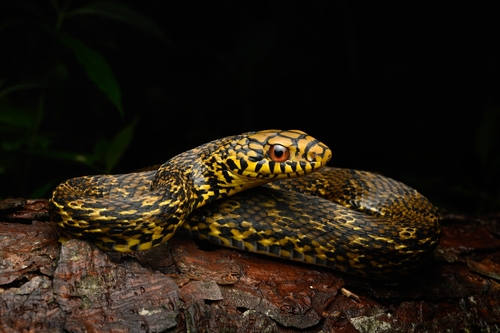
King Ratsnake
Elaphe carinata
A powerful and prominent hunter of the East Asian wilds, the King Ratsnake is famous for its impressive size, its 'king' status as a predator of other snakes, and its distinctive reticulated scales.
Quick Identification
Size
1.5–2.4 meters (5–8 feet) in length; weight typically 0.5–2.5 kg (1.1–5.5 lbs)
Colors
Yellowish-brown or olive-grey ground color with heavy black edging on scales creating a 'net' or reticulated pattern; juveniles are often grey with dark crossbands.
Key Features
- Heavily keeled (ridged) scales giving a rough, matte appearance
- Black-edged head scales often forming a pattern resembling the Chinese character for 'King'
- Large, muscular body with a distinct, broad head
- Produces a powerful, pungent odor from post-anal glands when disturbed
When You’ll See Them
Geographic range
Where Does the King Ratsnake Live?
The King Ratsnake is primarily native to the subtropical and temperate regions of East and Southeast Asia. Its core range encompasses a vast area of central and southern China, extending south into northern Vietnam and across the waters to the islands of Taiwan and the Ryukyu Archipelago of Japan. Within these territories, it is a versatile resident found from lowland plains to high-altitude mountain forests.
Basemap © OpenStreetMap contributors
Behavior
The King Ratsnake is a bold and formidable predator known for its confident and sometimes defensive temperament. Unlike many snakes that retreat immediately, this species may stand its ground, coiling its body and striking if it feels threatened. Its common name 'King' is derived from its ophiophagous nature—it frequently hunts and consumes other snakes, including venomous species, thanks to a natural resistance to many local toxins.
While largely terrestrial, they are proficient climbers and are often found exploring stone walls, rafters of outbuildings, or low tree branches in search of prey. They are highly active hunters that use a combination of site-scenting and visual tracking to locate food. In regions where they coexist with humans, they are often valued for their exceptional ability to suppress rodent populations, despite their habit of releasing a foul-smelling musk when handled, which has earned them the nickname 'stink snake.'
EverydayEarth exclusive
Camera Tips
To capture a King Ratsnake on your backyard or trail camera, focus on 'edge' habitats where two different environments meet. These snakes frequently patrol the base of stone walls, the boundary between a lawn and a wooded area, or the perimeter of agricultural fields. Set your camera at a low height—about 12 to 18 inches from the ground—and angle it slightly downward. Because they are large-bodied and move relatively slowly compared to lizards, they trigger PIR sensors reliably, but a wide-angle lens is best to capture their full length.
While you should never use food as a lure, you can attract these snakes by creating a 'micro-habitat' in front of your camera. A shallow, grounded water dish or a pile of flat, sun-warmed rocks will often draw them in for a drink or a basking session. In suburban settings, aiming your camera at potential rodent hotspots, such as the entrance to a woodpile or a crawl space, is a highly effective strategy, as the snakes will regularly check these areas for prey.
Lighting and timing are critical for the best footage. During the cooler spring and autumn months, focus your efforts on mid-morning basking spots that receive direct sunlight. In the heat of mid-summer, these snakes often shift to a crepuscular or even nocturnal schedule to stay cool. Ensure your camera is set to a high-sensitivity trigger and use high-definition video modes; the distinctive 'keeled' texture of their scales and the black-edged patterns on their heads are much easier to identify in video than in grainy night-time stills.
Similar Species
Species that look similar or are commonly confused with King Ratsnake.
Frequently Asked Questions
Record King Ratsnake at your habitat
Connect a camera to start building your own species record — AI identifies every visitor automatically.