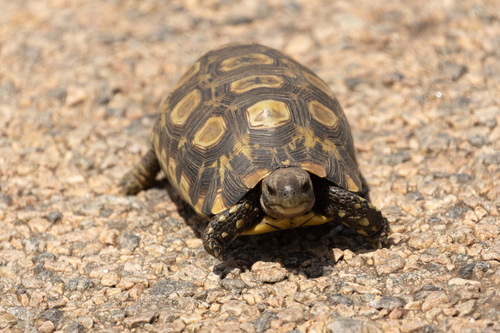
Bell’s Hingeback Tortoise
Kinixys belliana
Meet Africa’s 'transformer' tortoise, a resilient survivor known for its unique hinged shell and love for the rainy season. Discover how to spot this slow-moving wanderer in the savannas and woodlands of the central continent.
Quick Identification
Size
15 to 22 cm (6 to 9 inches) in length; weight typically 1 to 2 kg (2.2 to 4.4 lbs)
Colors
Olive, yellow, or reddish-brown carapace with dark radiating patterns or borders on the scutes. Plastron is usually pale yellow with dark blotches.
Key Features
- Movable hinge on the rear of the upper shell (carapace)
- Elongated, somewhat flattened shell shape
- Five claws on each front foot
- Radiating dark patterns on yellowish scutes
When You’ll See Them
Geographic range
Where Does the Bell’s Hingeback Tortoise Live?
This tortoise is a true child of the African continent, primarily calling the moist savannas and woodlands of Central and Eastern Africa home. Its native range extends from the grassy plains of Sudan and Ethiopia southward through the diverse landscapes of the Democratic Republic of the Congo and Uganda. While it avoids the harshest deserts and densest rainforests, it is well-adapted to the seasonal cycles of the tropical belt where grasslands meet the bush.
Basemap © OpenStreetMap contributors
Behavior
They are generally solitary and shy, spending much of the hot, dry season in a state of estivation, buried in leaf litter or underground burrows to conserve moisture. When active, they are determined travelers, navigating through tall grasses and scrubland with a surprisingly nimble gait for a chelonian.
While they are not social in the way mammals are, they may congregate around abundant food sources or water holes. To humans, they often appear timid, retracting into their shells at the first sign of danger, but they can become accustomed to living in suburban gardens if left undisturbed.
EverydayEarth exclusive
Camera Tips
To successfully capture Bell’s Hingeback Tortoise on camera, placement is everything. Since these tortoises are low to the ground, your camera should be mounted no more than 6 to 10 inches (15-25 cm) off the floor, angled slightly downward. Positioning the device along natural 'edges'—where tall grass meets a dirt path or at the base of a fallen log—is highly effective, as tortoises often use these as navigational guides.
Timing is the second secret to success. This species is most active during the rainy season or immediately following a heavy downpour. If you are using a trail camera in a backyard or garden setting within their range, focus on the 'golden hours' of early morning and late afternoon. During the heat of the day, they will likely be tucked away in the shade, so aim your lens toward cool, damp micro-habitats like the base of thick shrubs or near a water feature.
While you shouldn't disturb their natural diet, a shallow water dish or a pile of overripe fruit like papaya or mango can act as a natural lure to keep them in the frame longer. Because they move slowly, a single photo might only catch a glimpse of a shell before the shutter closes; setting your camera to a 'photo burst' or a 10-second video mode is highly recommended. This captures their fascinating walking gait and foraging behavior more reliably.
Ensure your camera's PIR (motion) sensor is set to high sensitivity. Because tortoises are cold-blooded and move slowly, they don't always trigger sensors designed for fast-moving, warm mammals. Checking your camera settings to ensure a fast trigger speed and high sensitivity will maximize your chances of seeing these 'hidden' backyard residents.
Similar Species
Species that look similar or are commonly confused with Bell’s Hingeback Tortoise.
Frequently Asked Questions
Record Bell’s Hingeback Tortoise at your habitat
Connect a camera to start building your own species record — AI identifies every visitor automatically.