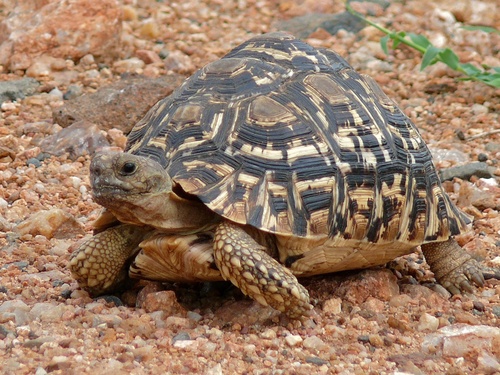
Leopard Tortoise
Stigmochelys pardalis
Adorned with a striking 'leopard' pattern of gold and black, this African giant is one of the most beautiful tortoises on the planet. A master of the savanna, the leopard tortoise is a resilient survivor that brings a touch of prehistoric wonder to any backyard or trail camera.
Quick Identification
Size
40–70 cm (16–28 in) in length; weighing 13–40 kg (29–88 lb)
Colors
High-contrast carapace with yellow-tan base and intricate black blotches or spots; skin is typically a uniform yellowish-brown
Key Features
- Highly domed shell with leopard-like black and gold patterns
- Thick, elephantine legs adapted for terrestrial movement
- Lack of a nuchal scute (the small plate above the neck)
- Pyramidal growth on scutes common in older individuals
When You’ll See Them
Sightings on EverydayEarth
May 14, 2026
A Leopard Tortoise is seen walking slowly across the dry, sandy soil. It pauses briefly among the sparse grass before continuing its journey toward the left of the frame.
Geographic range
Where Does the Leopard Tortoise Live?
The leopard tortoise is native to the African continent, maintaining a widespread presence across the eastern and southern regions. Its range extends from the arid landscapes of Sudan and Ethiopia southward through Kenya and Tanzania, eventually covering nearly the entirety of Southern Africa including South Africa, Namibia, and Botswana. This resilient reptile thrives in sub-Saharan environments but conspicuously avoids the humid, dense rainforests of Central Africa.
Basemap © OpenStreetMap contributors
Behavior
The leopard tortoise is a slow-moving, solitary grazer that spends much of its day roaming for food. Unlike many other tortoise species, they do not dig their own burrows, though they are quite opportunistic. During extreme temperatures—either the scorching midday heat or cold winter nights—they frequently seek refuge in abandoned holes made by aardvarks, jackals, or foxes.
These tortoises are generally docile and will retract their head and limbs into their shell with a characteristic 'hiss' (caused by the sudden expulsion of air) when threatened. While they are usually quiet, during the mating season, males can become surprisingly vocal, emitting grunts and wheezing sounds as they compete for females or during the act of mating. In suburban areas of Africa, they are known to follow predictable routes through gardens, often returning to the same sleeping spots for several nights in a row.
EverydayEarth exclusive
Camera Tips
To capture high-quality footage of a leopard tortoise, camera placement is the most critical factor. Because these tortoises move low to the ground, your camera should be mounted no higher than 12 to 18 inches. Angling the lens slightly downward ensures you capture the intricate details of the shell patterns rather than just the top of the dome. If you're setting up in a backyard, look for 'tortoise highways'—worn paths through the grass or gaps under fences that they use daily.
While they are slow, their movement can sometimes be too subtle for low-sensitivity PIR sensors. We recommend setting your camera to 'High' sensitivity and using a short trigger interval. If your camera supports a time-lapse mode, setting it to take a photo every 5-10 minutes during the morning hours (8 AM to 11 AM) can often catch them grazing even if the motion sensor misses their slow-motion approach.
Attracting a leopard tortoise to a specific spot is best done with a shallow, ground-level water dish. They are attracted to the sight and sound of water, especially in drier months. Avoid using 'bait' like lettuce, as it lacks nutrition, but a patch of succulent plants or clover will keep them in the camera's field of view for much longer as they graze. Remember that these are powerful animals; ensure your camera is securely staked down, as an adult tortoise can easily bowl over a light tripod while investigating a new object in its path.
Similar Species
Species that look similar or are commonly confused with Leopard Tortoise.
Frequently Asked Questions
Record Leopard Tortoise at your habitat
Connect a camera to start building your own species record — AI identifies every visitor automatically.