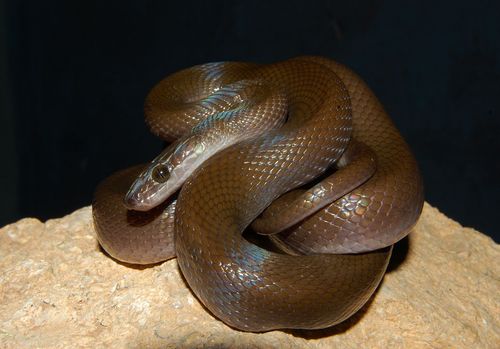
Brown House Snake
Boaedon fuliginosus
The Brown House Snake is Africa's gentle night-watchman, a harmless constrictor that provides invaluable pest control for suburban backyards and rural farms alike.
Quick Identification
Size
60–120 cm (24–47 inches); females are significantly larger and heavier than males.
Colors
Uniform dark brown to reddish-brown or olive; belly is cream or pearly white; distinctive pale white stripes extend from the snout through the eye.
Key Features
- Two pale white stripes on each side of the head
- Vertical, cat-like pupils
- Smooth, highly iridescent scales
- Slender, muscular body with a distinct neck
When You’ll See Them
Geographic range
Where Does the Brown House Snake Live?
The Brown House Snake is a quintessential African species, native to the vast Sub-Saharan region. Its range extends across West and Central Africa, stretching from Senegal and Guinea through Nigeria and into the tropical regions of the Congo. While often confused with its southern relative, the Cape House Snake, the Brown House Snake is a dominant presence in the humid and semi-arid landscapes of the continent's midsection.
Basemap © OpenStreetMap contributors
Behavior
The Brown House Snake is a shy, nocturnal hunter that has earned its name through a long-standing association with human dwellings. They are exceptionally placid and non-venomous, relying on constriction to overcome their prey. Because they are attracted to the rodents that congregate around homes and farms, they are often considered a 'landowner's best friend' for their role in natural pest control.
During the day, these snakes are rarely seen, as they prefer to hide in dark, damp crevices, under corrugated iron, or within woodpiles. When night falls, they become active and surprisingly agile, capable of climbing low-hanging branches or walls in search of lizards and small mammals. Their temperament is famously docile; even when encountered in the wild, they are more likely to freeze or attempt a slow retreat than to strike.
EverydayEarth exclusive
Camera Tips
To capture a Brown House Snake on your AI camera, focus your efforts on the 'transit zones' between their hiding spots and their hunting grounds. Because they are strictly nocturnal, ensure your camera has high-quality infrared (IR) night vision. Position the camera low to the ground—no higher than 15 centimeters (6 inches)—and angle it slightly downward to capture the full length of the snake as it traverses the area.
The best locations for placement are near woodpiles, rockeries, or along the edges of garden sheds where rodents are likely to frequent. These snakes are creatures of habit and will often follow the same scent trails night after night. If you have a compost bin or a bird feeder that attracts mice, this is an ideal spot to aim your camera lens.
Since these snakes are cold-blooded, they are most active on warm, humid nights. Setting your camera to a 'Video' or 'Burst' mode is crucial; because snakes move with a fluid, slow motion, a single photo might only capture a tail or a blurry midsection. Use a high-sensitivity trigger setting, as their low profile and slow movement can sometimes fail to trip less sensitive sensors.
Similar Species
Species that look similar or are commonly confused with Brown House Snake.
Cape House Snake
Found primarily in Southern Africa; has similar head stripes but often has a more olive or gray-brown hue compared to the chocolate-brown B. fuliginosus.
Mole Snake
Much larger and heavier-bodied with a more pointed snout; it lacks the distinctive white eye stripes of the house snake.
Frequently Asked Questions
Record Brown House Snake at your habitat
Connect a camera to start building your own species record — AI identifies every visitor automatically.