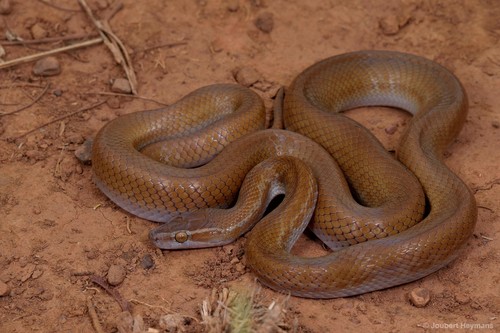
Cape House Snake
Boaedon capensis
The ultimate backyard ally, the Cape House Snake is a non-venomous rodent hunter that thrives in the shadows of Southern African gardens. With its iridescent scales and distinctive head stripes, it is a master of the night.
Quick Identification
Size
60-90 cm (24-35 inches) on average; large females can reach 1.2 m (4 feet). Weight typically ranges from 100-400g.
Colors
Uniform light brown to dark chocolate or olive-green. Features two distinct pale stripes on the sides of the head passing through the eyes. Belly is a characteristic pearly white.
Key Features
- Two pale cream stripes on the side of the head
- Smooth, glossy scales with an iridescent sheen
- Vertical 'cat-eye' pupils
- Pearly white or cream-colored underside
- Slender, muscular build
When You’ll See Them
Geographic range
Where Does the Cape House Snake Live?
Native to the southern and eastern regions of the African continent, the Cape House Snake is a widespread and highly adaptable reptile. Its core range spans across South Africa, Botswana, Zimbabwe, and Mozambique, reaching into parts of Zambia and Namibia. Because they thrive in human-modified environments, these snakes are frequently encountered in residential neighborhoods and agricultural lands where their prey is abundant, making them one of the most common snakes seen in Southern African backyards.
Basemap © OpenStreetMap contributors
Behavior
The Cape House Snake is a nocturnal powerhouse, renowned for its calm temperament and exceptional hunting skills. In the wild and suburban gardens alike, they act as a natural form of pest control, spending their nights tracking the scent trails of rodents. Unlike many more aggressive species, they are non-venomous and generally reluctant to bite unless severely provoked, making them one of the most 'human-friendly' snakes in Southern Africa.
During the day, they are masters of concealment, hiding under garden refuse, rocks, or inside wall cavities to escape the heat and predators. They are solitary creatures, only seeking out others during the spring mating season. When confronted, they may flatten their heads or strike as a bluff, but they much prefer to glide silently into the shadows of a backyard woodpile or shrubbery.
EverydayEarth exclusive
Camera Tips
To capture the Cape House Snake on camera, placement is everything. These snakes are ground-dwellers that stick to 'edge' habitats where they feel secure. Position your camera no more than 6-10 inches off the ground, aiming it along the base of a garden wall, a stack of firewood, or the edge of a dense flower bed. These are the 'highways' snakes use to move through a backyard undetected.
Since they are strictly nocturnal, ensure your camera has a high-quality infrared (IR) flash. Standard white flashes will often startle the snake, causing it to flee before you get a clear shot. Set your PIR (Passive Infrared) sensor to maximum sensitivity, as snakes are cold-blooded and may not always trigger sensors designed for warm-blooded mammals unless they have recently been basking or the ambient temperature is high.
While you shouldn't use food bait (which can attract unwanted pests or harm the snake), you can increase your chances by placing the camera near a known 'lizard lek' or a spot where you've seen rodent activity. The best time for activity is on warm, humid nights, particularly after a light rain shower when the humidity is high and their prey is active. Use a 'Burst Mode' or short video clips (10-15 seconds) to capture their fluid, rhythmic movement.
Similar Species
Species that look similar or are commonly confused with Cape House Snake.
Frequently Asked Questions
Record Cape House Snake at your habitat
Connect a camera to start building your own species record — AI identifies every visitor automatically.