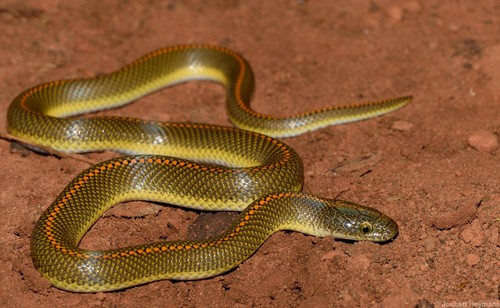
Aurora House Snake
Lamprophis aurora
With its stunning olive-green scales and a brilliant yellow 'racing stripe' down its back, the Aurora house snake is one of Southern Africa's most beautiful and harmless garden visitors. This nocturnal constrictor is a quiet guardian of the backyard, specializing in keeping rodent populations under control.
Quick Identification
Size
Typically 45–60 cm (18–24 inches) in length, occasionally reaching up to 90 cm (35 inches).
Colors
Olive-green to dark green body with a vivid yellow or orange-yellow stripe running down the spine; underside is creamy-white.
Key Features
- Distinct bright yellow or orange vertebral stripe
- Dull olive-green body coloration
- Creamy-white to pale yellow underside
- Small, smooth scales with a glossy sheen
- Highly secretive, terrestrial behavior
When You’ll See Them
Geographic range
Where Does the Aurora House Snake Live?
This striking serpent is native to the African continent, specifically the southern regions. Its core range is concentrated within the Republic of South Africa, particularly across the Highveld and coastal provinces, as well as the mountainous kingdoms of Lesotho and Eswatini. It thrives in various biomes from sea level to high-altitude grasslands, making it a familiar neighbor in both rural and suburban southern African landscapes.
Basemap © OpenStreetMap contributors
Behavior
The Aurora house snake is a shy, nocturnal species that spends much of its time hidden beneath rocks, logs, or debris during the daylight hours. Unlike some of its bolder relatives, this snake is remarkably docile and rarely attempts to bite when encountered, instead relying on its cryptic coloration and secretive nature to avoid detection.
As a constrictor, it is an efficient hunter that emerges after dark to forage for prey. While it is generally solitary, multiple individuals may be found in areas with high rodent populations or ideal shelter. In suburban environments, they are beneficial residents, often moving through garden leaf litter unnoticed while keeping local pest populations in check.
EverydayEarth exclusive
Camera Tips
To capture the elusive Aurora house snake on camera, placement is everything. These snakes are strictly terrestrial and rely on 'wildlife highways'—the edges where different habitats meet. Position your camera at ground level, ideally parallel to a garden wall, a stack of firewood, or a large rockery. Because they are small and low-profile, the camera should be angled slightly downward and placed no more than 12-18 inches from the path you expect the snake to take.
Since reptiles don't always trigger standard PIR sensors as effectively as warm-blooded mammals, it is crucial to use a camera with high sensitivity settings or a time-lapse mode. If your camera allows for it, set the trigger interval to the shortest possible duration to ensure you catch the snake as it glides through the frame. Use infrared (no-glow) flash to avoid startling the snake or other nocturnal garden visitors.
While you cannot 'bait' a snake with food in the traditional sense, you can increase your chances by placing the camera near a water feature or a known rodent run. Aurora house snakes are particularly active after a summer rain when the humidity is high and their prey is on the move. Focus your efforts during the warmer months from late spring to early autumn, as they may become inactive or undergo brumation during the colder winter months.
Similar Species
Species that look similar or are commonly confused with Aurora House Snake.
Frequently Asked Questions
Record Aurora House Snake at your habitat
Connect a camera to start building your own species record — AI identifies every visitor automatically.