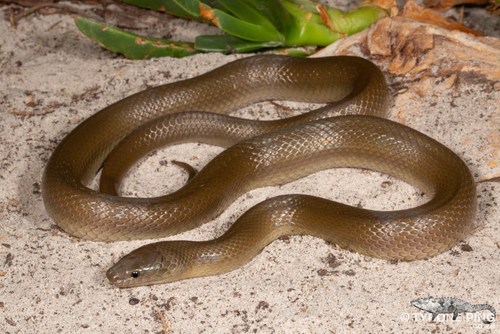
Olive House Snake
Elaiophis inornatus
Glossy and graceful, the Olive House Snake is a nocturnal guardian of the garden. This harmless constrictor is a master at rodent control, gliding through the shadows of Southern Africa's moist grasslands and suburbs.
Quick Identification
Size
Typically 45–90 cm (18–35 in), though large females can occasionally reach 130 cm (51 in).
Colors
Uniformly olive-green, olive-brown, or dark grey-black across the back; the belly is contrastingly pale, usually creamy-white or light yellow.
Key Features
- Uniform dark olive or grey body with no stripes or patterns
- Smooth, highly glossy scales that shimmer in light
- Vertical pupils (cat-like eyes) suited for night hunting
- Cream-colored or pale yellow underside
When You’ll See Them
Geographic range
Where Does the Olive House Snake Live?
The Olive House Snake is native to the southern African continent, with a range heavily concentrated in the Republic of South Africa. It is a common resident along the southern and eastern coastal regions, from the Western Cape through the Eastern Cape and into KwaZulu-Natal, extending inland to the highveld of Mpumalanga and Limpopo. It is also native to the mountain kingdoms of Lesotho and Eswatini, where it thrives in temperate and subtropical zones with high annual rainfall.
Basemap © OpenStreetMap contributors
Behavior
The Olive House Snake is a shy, secretive, and entirely non-venomous constrictor. Known for its exceptionally docile temperament, this snake rarely bites even when handled or cornered, preferring to remain still or slowly glide toward cover. It is a nocturnal specialist, spending the heat of the day hidden beneath rocks, rotting logs, or in the cool foundations of human structures.
As a highly efficient predator of rodents, it is considered one of the most beneficial snakes to have in a suburban environment. It is a solitary creature, but it may frequent the same garden for years if there is a steady supply of mice and adequate damp shelter. In the wild, it is often found near water sources or in moist leaf litter where its prey is most abundant.
EverydayEarth exclusive
Camera Tips
Capturing an Olive House Snake on an AI-powered camera requires a strategic focus on ground-level movement in moist, dark corridors. These snakes are highly predictable in their movement, often hugging the edges of walls, fences, or garden borders. Position your camera just 10 to 15 centimeters (4 to 6 inches) off the ground and angle it slightly downward to capture their sleek, low-profile bodies as they transit through the frame.
Because they are strictly nocturnal, your camera’s infrared (IR) performance is critical. Since snakes are cold-blooded, traditional Passive Infrared (PIR) sensors can sometimes fail to trigger if the snake's body temperature matches the ground temperature. To overcome this, place your camera near a 'heat sink' like a paved path or a brick wall that retains day-time warmth; as the snake moves across these warmer surfaces at night, the thermal contrast is improved. Alternatively, use a time-lapse mode with short intervals (e.g., every 30 seconds) during the first three hours after sunset.
Focus your efforts near 'prey hotspots.' Locations such as compost heaps, woodpiles, or the base of bird feeders—where mice and lizards are likely to gather—are prime hunting grounds for the Olive House Snake. Avoid using bright white-flash cameras as they may startle the snake; 'No-Glow' or 'Black' IR LEDs are far more effective for observing their natural hunting behavior without interference. The best footage is typically captured on humid, warm nights following a light rain, as these conditions stimulate both the snake and its prey into activity.
Similar Species
Species that look similar or are commonly confused with Olive House Snake.
Frequently Asked Questions
Record Olive House Snake at your habitat
Connect a camera to start building your own species record — AI identifies every visitor automatically.