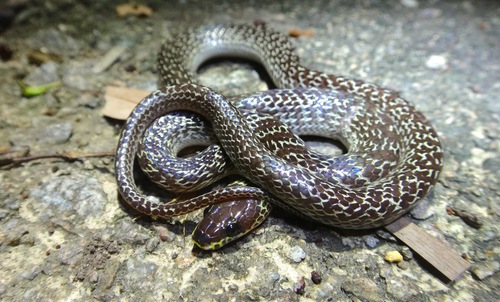
Common Wolf Snake
Lycodon capucinus
A slender, nocturnal climber often found in garden walls and rafters, the Common Wolf Snake is a non-venomous gecko specialist with a 'canine' look.
Quick Identification
Size
Typically 40–60 cm (16–24 inches), with exceptional specimens reaching up to 75 cm (30 inches).
Colors
Dark chocolate brown or purplish-gray body with a fine, marble-like network of white or yellow spots; belly is creamy white.
Key Features
- Squarish snout with enlarged 'canine-like' front teeth
- Slender, slightly flattened body
- Intricate white reticulated pattern on a dark background
- Pale yellowish 'collar' usually visible on the neck of juveniles
When You’ll See Them
Geographic range
Where Does the Common Wolf Snake Live?
Native to the vast Indo-Australian Archipelago, the Common Wolf Snake thrives across Southeast Asia, including Thailand, Malaysia, Singapore, Vietnam, and Cambodia. Its core population extends throughout the thousands of islands in Indonesia and the Philippines. This species is also a successful traveler; it has been introduced to several other regions including Christmas Island and the Cook Islands, where it has established self-sustaining populations.
Basemap © OpenStreetMap contributors
Behavior
The Common Wolf Snake is a remarkably adaptable and bold reptile that has successfully moved from the forests into the heart of human suburbs. It is primarily a nocturnal hunter, spending the daylight hours squeezed into tight, dark crevices such as stone wall gaps, under floorboards, or beneath piles of garden debris. They are exceptional climbers, frequently seen scaling vertical brick walls or trees in search of their favorite prey.
Despite being completely non-venomous, this snake is known for its feisty temperament. When cornered or startled, it will not hesitate to strike repeatedly and may vibrate its tail against dry leaves to mimic the sound of a rattlesnake. This defensive display is a bluff, as they prefer to flee if given the opportunity. Because they are attracted to the geckos that live in houses, they are one of the most common snakes found indoors in Southeast Asia.
EverydayEarth exclusive
Camera Tips
Capturing the Common Wolf Snake on a backyard camera requires a strategy focused on verticality and prey. These snakes are gecko-hunting specialists, so the best place to mount your camera is facing a textured exterior wall, a garden fence, or a stone pillar. If you have an outdoor light that attracts insects, place your camera nearby; the light draws in geckos, which in turn acts as a natural lure for the Wolf Snake.
Because they are strictly nocturnal, high-quality infrared (IR) night vision is a must. Position your camera at roughly chest height (1.5 meters) and angle it slightly downward to scan the surface of the wall or the junction where the wall meets the ground. These snakes often travel along 'edges' to remain hidden, so gaps between garden pots or the corners of a patio are high-traffic zones.
Set your camera to a high sensitivity with a fast trigger speed. Common Wolf Snakes move with a quick, flowing motion when they are on the hunt, and a slow sensor might only capture a disappearing tail. Using a short video clip mode (10-15 seconds) is often more rewarding than still photos, as it allows you to observe their unique climbing techniques and tongue-flicking behavior as they track lizard scents.
For the best results, monitor your camera after a light evening rain. The increased humidity often stimulates activity, and the snakes are more likely to move across open patio tiles or damp garden paths where they are easier to spot against the ground. Ensure your camera is set to 'Night Mode' only if you want to save battery, as you are very unlikely to see this species during the day.
Similar Species
Species that look similar or are commonly confused with Common Wolf Snake.
Frequently Asked Questions
Record Common Wolf Snake at your habitat
Connect a camera to start building your own species record — AI identifies every visitor automatically.