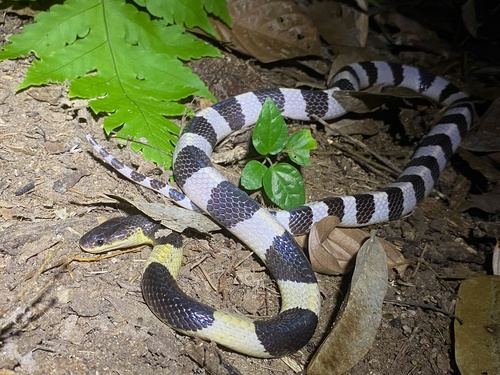
Malayan Krait
Bungarus candidus
A striking master of the night, the Malayan Krait is one of Southeast Asia's most enigmatic and venomous residents. With its bold black-and-white bands and secretive nature, this nocturnal predator is a rare but fascinating find for backyard wildlife enthusiasts.
Quick Identification
Size
100-160 cm (3.3-5.2 feet) in length; slender, slightly compressed body.
Colors
Highly distinct alternating bands of glossy bluish-black and stark white or yellowish-white. The bands often narrow toward the belly, which is uniformly white.
Key Features
- Bold black and white crossbands that encircle the body
- Enlarged hexagonal scales running down the center of the back
- Small, dark eyes that blend into a black, rounded head
- Triangular body cross-section with a blunt tail
When You’ll See Them
Geographic range
Where Does the Malayan Krait Live?
The Malayan Krait is native to the tropical regions of Southeast Asia, where it maintains a widespread presence. Its core range includes Thailand, Cambodia, Vietnam, and West Malaysia, and it is a common sight across the Indonesian islands of Sumatra, Java, and Bali. While it is primarily a lowland specialist, it is highly adaptable and can be found in both undisturbed primary forests and heavily modified human environments like plantations and village outskirts.
Basemap © OpenStreetMap contributors
Behavior
The Malayan Krait is a primarily nocturnal species with a paradoxical personality. During the daylight hours, it is remarkably shy and lethargic, often seeking refuge in rodent burrows, hollow logs, or under heavy leaf litter. If disturbed during the day, it typically tucks its head under its body coils in a defensive, non-aggressive posture. However, as night falls, the krait transforms into an active and alert hunter, becoming significantly more dangerous and prone to striking if it feels threatened.
Socially, these snakes are solitary and secretive. They are highly venomous, possessing a potent neurotoxin that can cause respiratory failure in humans. Despite their proximity to human settlements in many parts of Southeast Asia, bites are relatively rare because of the snake's preference for flight over fight. They spend much of their active time on the ground, though they are capable of crossing shallow water and navigating low-lying vegetation in search of prey.
EverydayEarth exclusive
Camera Tips
To capture high-quality footage of a Malayan Krait, camera placement is everything. These snakes are ground-dwellers that follow scent trails, so mount your camera very low—roughly 10 to 15 centimeters (4-6 inches) above the ground. Angle the lens slightly downward to ensure the motion sensor triggers when the snake's slender body glides through the frame. Because they are strictly nocturnal, a camera with 'No-Glow' or 'Black' infrared LEDs is essential to avoid startling the snake or alerting potential prey in the area.
Focus your efforts on 'edge' habitats. The perimeter where a garden meets a forest, or the line where a stone wall meets tall grass, serves as a natural highway for kraits. Areas near water, such as drainage ditches or the banks of garden ponds, are also hotspots as the krait hunts for frogs and other snakes. If you are struggling to get them in frame, you can use a 'drift fence'—a simple 10-foot stretch of low landscaping mesh or wood that funnels the snake directly past your camera lens.
Set your camera to record short video clips (15-20 seconds) with a high trigger speed. Snakes move with a fluid motion that is often better captured on video than in still photos, allowing you to see the distinctive hexagonal scales along the spine for positive identification. Be extra vigilant during the wet season, as the humidity brings these snakes out more frequently. Always remember that this is a dangerously venomous species; never attempt to move a camera or clear brush near it by hand if you suspect a krait is nearby.
Similar Species
Species that look similar or are commonly confused with Malayan Krait.
Frequently Asked Questions
Record Malayan Krait at your habitat
Connect a camera to start building your own species record — AI identifies every visitor automatically.