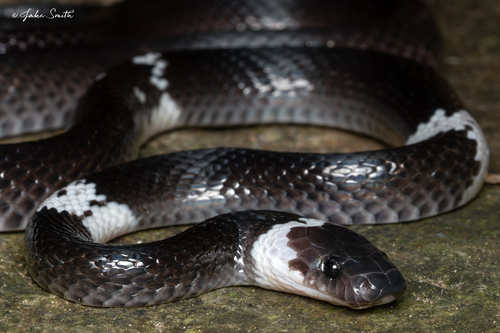
Malayan Banded Wolf Snake
Lycodon subcinctus
A master of disguise and a champion lizard-hunter, the Malayan Banded Wolf Snake is a harmless backyard resident often mistaken for its more dangerous cousins. Discover how this nocturnal climber navigates the shadows of Southeast Asian gardens.
Quick Identification
Size
60-90 cm (24-35 inches) on average; maximum length approximately 120 cm (47 inches).
Colors
Glossy black or dark chocolate brown body with distinct white or cream crossbands; bands often fade in older adults.
Key Features
- Broad white crossbands on the front half of the body
- Flattened, shovel-shaped head slightly wider than the neck
- Bands become faint or disappear toward the tail in adults
- Small, dark eyes with vertical pupils
When You’ll See Them
Geographic range
Where Does the Malayan Banded Wolf Snake Live?
This striking reptile is a native of Southeast Asia, spanning a wide tropical corridor from northeast India and southern China through Myanmar, Thailand, and Vietnam. It is particularly common throughout the Malay Peninsula and across the Indonesian archipelago, including the islands of Sumatra, Java, and Borneo, as well as parts of the Philippines. Thriving in humid, lowland environments, it has successfully adapted to human-altered landscapes across these regions.
Basemap © OpenStreetMap contributors
Behavior
The Malayan Banded Wolf Snake is a shy, nocturnal hunter that spends its daylight hours tucked away in leaf litter, rock crevices, or under the floorboards of houses. Despite its somewhat intimidating appearance and mimicry of venomous species, it is non-venomous and generally avoids confrontation with humans. When it feels threatened, it may flatten its body to appear larger or strike defensively if cornered, but its primary instinct is to flee into the nearest dark crevice.
As an adept climber, it is frequently spotted navigating vertical surfaces like garden walls and rafters in search of its favorite prey. In suburban environments, it plays a vital role as a natural pest controller, keeping populations of house geckos and skinks in check. While they are solitary creatures, they are quite common in areas where food is abundant, often living in close proximity to humans without ever being detected due to their secretive nature.
EverydayEarth exclusive
Camera Tips
To capture high-quality footage of the Malayan Banded Wolf Snake, position your camera near low-lying structural edges or 'runways' where lizards congregate. Since these snakes are nocturnal lizard specialists, placing cameras near outdoor light fixtures—which attract insects and, subsequently, the geckos the snake hunts—is a winning strategy. Aim the lens about 6 to 12 inches off the ground, focusing on garden walls, woodpiles, or the base of large trees where they transition from ground to trunk.
Because snakes do not always reliably trigger standard Passive Infrared (PIR) sensors due to their cold-blooded nature, use a camera with a high-sensitivity setting or, better yet, a time-lapse mode set to short intervals during the first few hours of darkness. Ensure your camera has a strong infrared (IR) flash for crisp black-and-white night images, as these snakes are almost exclusively active after sunset. If your camera allows for focal adjustment, set it for a close-up range (1-2 meters), as these snakes are relatively slender and can be missed by wide-angle shots.
Seasonality plays a role in their visibility; you are significantly more likely to record activity during the wet season when humidity is high and prey is most active. Avoid using chemical lures, as these are rarely effective for wolf snakes. Instead, focus on 'natural' attractants like a stack of damp terracotta pots or a pile of loose rocks, which provide the perfect humid microhabitat that these snakes seek out for resting and hunting. Check your footage carefully, as their banded pattern provides excellent camouflage against dappled leaf litter.
Similar Species
Species that look similar or are commonly confused with Malayan Banded Wolf Snake.
Malayan Krait
The Krait has a distinct ridge along its spine with enlarged hexagonal scales and its white bands are usually much narrower and more regular.
Common Wolf Snake
The Common Wolf Snake (Lycodon capucinus) usually has a more mottled or 'salt and pepper' pattern rather than the distinct wide bands of the Malayan Banded species.
Frequently Asked Questions
Record Malayan Banded Wolf Snake at your habitat
Connect a camera to start building your own species record — AI identifies every visitor automatically.